Thailand

Translate this page to French Translate this page to German Translate this page to Italian Translate this page to Russian Translate this page to Japanese


Culture
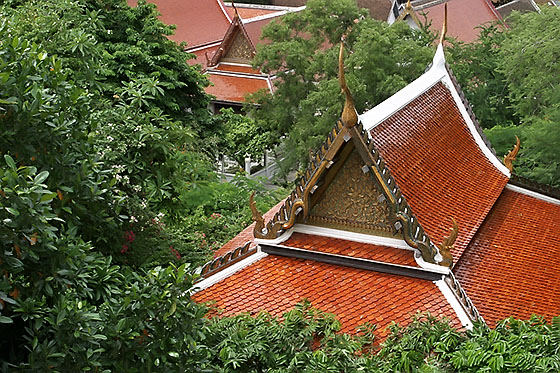
Buddhist Temple, Hat Yai
Photo: Buddhist Temple, Hat Yai

What's On This Page?


Thailand - Culture Page 1

Overview

Image of a famous monk at a temple in Bangkok - Click for larger image What is culture? One dictionary definition I found describes it this way, "The predominating attitudes and behaviour that characterise the functioning of a group or organization." Some guide books seem happy to put together a simple list to describe Thai Culture. "Thais are Buddhists, they eat rice, wai instead of shaking hands, you shouldn't touch their heads and don't point your feet at them". That was easy, wasn't it?
At the time of writing I have lived in Thailand for about two years. There are certain traits and patterns of behaviour I have seen that at first I didn't perceive as culture, just things that seemed a bit unusual. However, after seeing the same things time and again (and also from hearing other foreigners describing similar behaviour) it seems that certain traits are cultural.

The subject is extremely complex and I know little of it although my understanding is growing. I believe that if I spent the rest of my life in Thailand and mastered the language completely I still wouldn't fully understand the culture. On this page I will try to describe some of the behaviour I have observed. For certain behaviour I may have an idea why but other actions and behaviour still leave me totally baffled.

The best advice I can give to anyone visiting Thailand is to try to forgot your own values and perceptions. The culture in Thailand is SO different that it is futile trying to apply Western values. On short vacations cultural problems do not arise very often. Once living in Thailand though they start to crop up with increasing regularity and can be difficult to comprehend.

Although certain types of cultural behaviour can be difficult to understand it is the culture that makes Thailand the amazing country it is. There is probably not a more friendly or welcoming place on earth and this is because of such cultural qualities as non-confrontation, face-saving, tolerance and keeping cool.

Return to top of page

Cultural Insensitivity

Last updated: 16th June 2007

Regarding Thais and non-Thais in Thailand (generally speaking), there is a lot of ignorance on both sides about the other side's culture. This can be good and bad. Thais understand that most foreigners are ignorant of their ways and make allowances; thus it is difficult to upset anyone.

It is especially difficult to upset Thais if you don't speak Thai but once you learn how to speak Thai it becomes remarkably easy!

The hypocrisy shown by Thai people concerning cultural insensitivity is incredible. A BBC News report blares out the headline - Thais to publish etiquette guide.

This was all about an American film showing a farang actor sitting on the head of a Buddha image, which is a big taboo in Thailand.

However, what about young Thais walking around with, "Fuck off Nazi punks," written on their T-shirts. Worse still are the WW2-style German helmets that some Thais wear while riding their motorbikes instead of proper crash helmets that might actually protect their heads in the event of an accident.

They wear black Nazi storm trooper helmets which feature a Swastika on one side and an 'SS' flash on the other. A significant proportion of tourists in Thailand are German, and Jewish people also visit the country but the people who wear such attire do not have a solitary inkling that it might actually be culturally insensitive.

This imagery is so offensive in Germany that it is banned but in Thailand it is just fashion.

Return to top of page

The Thai Value System

The four-faced Brahma Sahampati at the Erawan hotel shrine in Bangkok - Click for larger image I mentioned above that it is important in Thailand to try to forget your own cultural values but this can be difficult because they seem to make a lot of sense. If you live in Thailand, teach in Thailand or have a Thai partner there will be times when certain behaviour seems crazy.

Understanding a little about the culture may help to explain what's going on. If you are thinking about living in Thailand after having enjoyable vacations, thinking about teaching there or thinking about getting a Thai partner it also helps to understand something about Thai cultural values.

A good place to start is by reading The Thai Character. This article is available at various Internet sites and is quite insightful.

Teaching Thai students English can be extremely frustrating due to their apathy, laziness and general lack of interest and motivation. This doesn't apply to all students but certainly to many I have encountered.

It might be useful to know that in a list of set values, being ambitious and hardworking to attain one's goals is the least important to Thais whereas massaging egos and creating smooth relationships with others are important.

Return to top of page

Thailand Thailand

Inside Thai Society by Niels Mulder

One of the definitive books on Thai culture by an anthropologist who has been studying the subject since 1965. It took me a long time to get hold of a copy (one of the problems of living in provincial Thailand) but on a trip to Phuket it was sitting on a bookshop shelf and it should be easy to find anywhere in Thailand where there are lots of foreigners.

If I had managed to get hold of a copy sooner it would certainly have helped my understanding of certain baffling situations.

It is a book that will probably appeal more to people who have been living in Thailand for a while who can relate to the behaviour patterns discussed, rather than casual tourists. Like the John Laird book, Mulder's comments about Thai politics are frighteningly accurate even though both books are now getting quite old.

While the latest political scandal in Thailand was raging during January/February 2006 I picked up this book, as I often do for a quick bedtime read before sleeping. On the back page I re-read the following:

"To understand Thai interaction, one should over and above all else understand power as the central axis around which public life resolves. It is power and/or rank that lead to the prestige and social visibility that are the highest social goals. To be big, to be the boss and give orders, to demonstrate social superiority, and to present one's status are the supreme motives for personal fulfilment and achievement. Socially, therefore, the amassing of power is desirable, admired and respected; it is a means of self-aggrandizement and is a commodity to enjoy. Nowadays, this enjoyment leads to a flagrant materialism, a never quenched thirst for money and obsessive consumerism."

Anyone who has followed the Ample Rich share-selling scandal will immediately understand how accurate this statement is and how it helps to explain what has been going on. It might also explain why you see so much expensive German and Japanese automotive hardware on the roads of Thailand and why people buy mobile phones that cost the equivalent of three month's wages. Not to mention the organisation charts prominently displayed in every office throughout Thailand showing the structure of power for all to see.

The book shows that even though the world has changed tremendously since the beginning of the 21st century Thai politics continues with all same the old problems. What is concerning is that the underlying cause is Thai culture and that same culture will not allow significant change. This is not a good prospect for Thailand but, as the book suggests, the Thais are a pragmatic people. The problems will get fixed eventually, somehow, but there may be some pain encountered on the way.

I cannot recommend this book highly enough. It is not a light read (I found myself reading certain paragraphs over and over again) but it reveals some amazing truths.

Inside Thai Society - Religion, Everyday Life, Change
by
Niels Mulder

ISBN: 974-7551-24-1

Published by:
Silkworm Books
104/5 Chiang Mai-Hot Road, M.7,
Suthep, Muang, Chiang Mai 50200, Thailand
E-mail: silkworm@loxinfo.co.th

Return to top of page

Morality

Busy street market in Bangkok - Click for larger image Many mixed messages come out of Thailand regarding morality. For example, Thai males consume a huge amount of alcohol but when a beer manufacturer was set to float on the Thai stock exchange there were massive street protests in Bangkok. Buddhism advocates 'right-mindedness' and, as we all know, right-thinking is not easy after four bottles of beer or half a bottle of whisky. Buddhism therefore advises people to abstain from alcohol.

Conservative Buddhist Thais were therefore upset that an alcohol company should be listed on the stock exchange. No one seemed too bothered about actual alcohol problems in Thailand, notably drink-driving. The whole thing seemed to be a 'face' issue. The concern wasn't about the real dangers of alcohol in society but just about what other people thought of Thailand.

The subject of uniforms worn by female university students pops up fairly regularly. The basic uniform is a white blouse and black skirt but there are many variations on the theme. Girls can wear long black skirts, baggy blouses and flat shoes which don't set anyone's pulse racing.

On the other hand they can wear black micro-skirts with slits, blouses which appear to be about three sizes too small and high, strappy shoes. Every time they breathe in deeply you fear (hope?) a button might pop off and take out your eye.

This is a popular 'morality' subject on TV as it gives the TV companies a good excuse to show lots of sexy students while at the same time condemning their 'loose' appearance. My girlfriend gets quite upset and I have to nod my head in agreement with her. There's nothing worse in Thailand than the sight of university girls in black micro skirts and tight blouses.

Another favourite is the subject of 'spaghetti' strap tops which are favoured by some Thai girls. During the Songkran festival in 2005 girls were ordered not to wear such apparel in the vicinity of Bangkok's Khaosan Road, a well-known farang backpacker haunt. The authorities obviously feared that the sight of a few girls in skimpy, wet tops would be enough to incite a farang riot.

Double standards aren't uncommon in Thailand. Throughout Thai history it has been quite acceptable for men to have several women but women are expected to be totally loyal and faithful. When the phenomena of 'gigs' appeared it got a lot of people hot under the collar. A 'gig' is what Thai girls describe as more than a friend but not a boyfriend.

As everyone knows, the country has a notorious reputation for prostitution but conservative Thais (of which there are many) get regularly upset when foreigners make public comments about it.

In the book, 'Bangkok Inside Out' (ISBN 979-97964-6-6) the authors include an entry on Patpong. The accompanying photo - taken inside a Patpong bar, presumably - shows a bare-breasted Thai girl sitting on the lap of a farang customer. A number is pinned to her skirt. She is girl number 79. The male customer whose lap she is sitting on has his hands clasped over her breasts. Both are grinning broadly in an atmosphere that reeks of alcohol and lust; lust for either sex or money. The photo caused a bit of a stir in Thailand.

However, this type of scene can be found in many tourist areas and in the same areas there will be many outwardly visible signs of prostitution so it seems a little contradictory - hypocritical even - that the locals get upset when it is brought to other people's attention.

Not really. The vast majority of Thais really do get upset by this portrayal of their country and are deeply offended by the reputation it gives Thailand but other aspects of Thai culture are coming into play. If they are that upset why don't they clamp down on prostitution, which is illegal anyway? Everyone knows where it exists so doing so would be easy.

For starters, thousands of poor villagers benefit from the money the girls earn. Supporting their families is an honourable thing for the girls to do, regardless of how they earn the money. Thais understand hardship in life and know that stopping the industry would make a lot of people suffer financially. This is something they wouldn't want to happen to other people because they have a lot of consideration for other people.

Another reason the industry is left alone is a little less savoury. Some Thais have got very rich from it and, because of the corruption that exists, so have some law enforcers and politicians. The people who have the power to close it down are also the ones who have a vested interest in keeping it going. There is also a sense that it isn't right to interfere in other people's business.

The thing about Thailand is that what you see on the surface isn't how things really are. Having in lived in Thailand now for a couple of years my observation is that the people are some of the most conservative I have ever come across. Don't be fooled by the general reputation and what goes on in a small minority of places.

Here's another 'moral panic' in Thailand story from the Nation; this time about 'coyote girls'.

Return to top of page

Petty Theft Among Thais

Street scene in Hat Yai - Click for larger image I hate to imply this is a cultural trait but I wasn't sure where to put it and as the problem only exists among Thais it doesn't represent a hazard to tourists. I first picked up on this after my girlfriend kept having problems but since then I have heard the same thing from quite a few Thais.

Very few young, unmarried Thais stay alone. Those that are working often share a room with colleagues. Partly, this is because of finances. Personally, I don't consider Bt6,000 a month to rent a room as being expensive but if someone only earns that amount in a month then it is expensive.

But it isn't only money; Thais aren't solitary creatures and don't like staying alone. Staying alone isn't sabai or sanuk and, if you are on your own, who will protect you from ghosts? Thais have a morbid fear of ghosts and don't like being alone for that reason.

They will either find a cheap room to rent or, as is often the case, there will be some free rooms available where they work as part of the job and two or three of them will share a room.

Iss had various things stolen including clothes, jewellery, money, books and a walkman. Some of these things I had bought her and some of the clothes (not cheap ones) hadn't even been worn. I was annoyed and we knew who the thief was but couldn't prove anything.

Just recently I sat next to a very pleasant girl on the bus from Phuket who was going home to Krabi to attend her sister's wedding. She worked at a high class clothes shop in Phuket and had suffered from the same problems while sharing a room with colleagues that had been provided with the job. Her expensive mobile telephone had been stolen.

In England this kind of thing isn't unknown. I have known of thefts in cricket clubs where one member has stolen from other members but to steal from friends, relatives, colleagues or fellow members of a club is seen about as low as you can get. But not so in Thailand apparently.

Return to top of page

Politeness

In a society which seeks a harmonious way of life at all times and where people do their utmost to avoid conflict, a high degree of politeness is essential. By being polite you can just about get anything you want in Thailand. Conversely, you won't get anywhere by showing anger, being disrespectful and being rude.

In polite company the levels of politeness get almost embarrassing. When you become familiar with the Thai language you will start to hear big differences in speech when people are being polite and when they aren't. The obvious words here are, "khrup," and "khaa," the polite particles for males and females. These words are used liberally in every sentence with polite speech.

On crowded sawng-thaews males will always stand up and offer their seat to women getting on board. (Interestingly though, people aren't as keen to offer their seats to women on long bus journeys. I was horrified on a bus journey from Chumpon to Hat Yai to see a very heavily pregnant woman sitting on a plastic stool in the aisle because no one would give up their seat. I was standing and wasn't particularly happy about not having a seat but the woman's predicament was far worse than mine.)

It is surprising then to sometimes encounter behaviour that appears quite rude. One topic popular with farangs in Thailand is the holding open of doors. Many Thais don't do this as a rule and sometimes when I have stood holding a door open for someone they walk straight through without even acknowledging my presence, let alone thanking me.

The pavements in Thailand are often blocked and there might only be enough room for one person to get through. In such situations I stop and stand aside if I see a person coming in the opposite direction. When I have done this in the past it isn't unusual for someone just to come barging past in the same direction. I wonder to myself if they realise why I am stood waiting there? Probably not.

Politeness is yet another one of those aspects of life in Thailand that is completely contradictory. I can only surmise it is due to how the Thais separate their world. When dealing with their inner circle (friends, family and colleagues), with officialdom and with people of a higher standing they are incredibly polite. Outside of this sphere however, there doesn't seem to be a need to exercise the same levels of politeness.

Whatever rules exist for politeness in Thai society they all seem to go out of the window when driving a vehicle. What is it about Thais in cars? Their behaviour changes completely. When on foot they have all the time in the world as you will know if ever you are in a crowded place and are trying to get somewhere in a hurry. But as soon as they get in a car or on a motorbike they are the most impatient people in the world.

I have just witnessed an incredibly rude scene that I could scarcely believe. In a supermarket car park a young Thai couple had just stepped on to a pedestrian crossing in order to enter the store. The husband was carrying a very young infant, only a couple of months old.

A car roared round the corner with absolutely no intention of stopping for pedestrians. The couple saw it in time and managed to step back on to the pavement. Did the driver apologise or anything? Like hell. He blasted his horn furiously because pedestrians in a car park had the audacity to try to cross on a pedestrian crossing. Thai drivers never stop for pedestrians.

This type of behaviour really makes me irate. I can't help but think that Thais in cars seem to think they are superior to people on foot just because they have a car so it is their right to be obnoxious to pedestrians.

Return to top of page

Rudeness and Arrogance

Last updated: 16th June 2007

I'm writing this after almost four years living in Thailand and it's not something I was expecting to write but the longer you stay in the country, the more you peel back the layers of the onion and see Thailand for what it really is.

As a newly-arrived tourist staying at reasonable hotels, with all the staff graciously wai'ing whenever they see you, it may seem as if Thai people are the most polite on earth. They also tend not to boast; being very modest and unassuming. The same cannot be said of most farangs.

Whenever I meet another farang in Thailand who has been in the country for more than a month, the first thing he will want to do is prove to me how much more he knows about Thailand than I do. Once he's finished his lecture, I read the Thai language menu for him and tell the waitress what he wants because he can't read or speak Thai but that doesn't stop him being an expert on Thailand.

Unfortunately, I have met some incredibly rude and arrogant Thais and they are just as obnoxious as rude and arrogant people from anywhere else. The good thing about Thailand though is that this kind of behaviour is fairly rare.

I also think there is a subtle difference in the nature of the arrogance. In Western countries some people have naturally arrogant personalities but in Thailand I think a lot of it is cultural. Let me expand on this.

Thai society is extremely hierarchical and everyone knows their place. Some people near the top of the scale live their entire lives having other Thais act subserviently towards them and after a while they start to believe that they really are something special and that everyone should bow and scrape.

I've had a few problems with university professors because of this. They have their little empires on campus and are wai'ed to constantly by the students. You will find they have long lists of degrees from a life spent entirely in academia (even though they have no experience of the real world).

Some speak fairly good English, and this can (and frequently does), add to their arrogance and superiority complex. As a foreigner dealing with them, all is fine so long as you go along with what they want but as soon as they sense any dissent, that is when they start getting nasty.

Thais go through an elaborate ritual when they first meet, trying to work out who is the higher person in the social hierarchy. It is essential for them to get this sorted out before the meeting can continue and then the 'inferior' person will bow and scrape to the 'superior' person.

With a Thai university professor, for example, with a PhD and a string of degrees; once he realises that you do now have a long list of paper qualifications, he will assume he is superior. Of course, nothing will be stated verbally to this effect, and you certainly won't regard yourself as an inferior person but he will.

He will therefore expect you to do whatever he wants, just as would happen with an 'inferior' Thai. When you show some dissenting behaviour, this goes completely against the rules of Thai social hierarchy and can result in a loss of face which is a big issue in Thailand.

Some Thai girls can also be arrogant based on their perceived beauty. Physical beauty is highly prized in Thailand and Political Correctness doesn't exist. From an early age, pretty girls will be singled out as being something special in society; not so much girls from poor backgrounds but certainly those from middle class backgrounds.

Girls like this can be very, very snotty. The adjective in Thai is ying (หยิ่ง) and I've found it to be more of a problem in Bangkok than in the provinces.

Arrogance is a form of rudeness but lots of other forms of rudeness exist. I am treated very rudely like a piece of crap on almost every minivan journey I take. Low class Thais on the street talk about foreigners incessantly as they walk around while the foreigners probably can't understand anything that is said and in many situations I find the 'f' word rude and offensive. "Farang, farang, farang blah blah blah."

The other point to make is that awareness of rude behaviour and speech becomes a lot more apparent once you progress beyond the 'grinning, pointing and negotiating prices on a large calculator' stage.

My latest encounter with rudeness was while looking around for a magnifying glass. Some of my Thai dictionaries have very small fonts and sometimes it's a problem working out tone marks. I therefore went shopping for a magnifying glass.

The woman in the first shop greeted me with a, "What do you want to buy?" and wasn't happy when I said I didn't want to buy; that I wanted to look first. A medium sized magnifying glass came down in price to Bt120 from about Bt150 but I wanted to look elsewhere first.

When I walked out they shouted at me that I could have it for Bt100 and there were some more comments when I declined the final price. I didn't hear what was said but no doubt it wasn't very complimentary.

I wasn't worried about the price but the quality was terrible and I was hoping to find something better. At another shop they just had the same low-quality 'Made in China' models. I asked about the same one I had just been told was Bt100 and the woman told me Bt150 - a big rip off.

I told her I'd think about it. She asked me why I needed to think about it. I thought about telling her it was because her price was 50% higher than the other place so she was obviously trying to rip me off but decided not to say anything.

As I walked out of the shop she started ranting aggressively to another woman about the farang who just came in and didn't buy anything (as if I don't have the right not to buy anything). I couldn't believe it and I was livid.

I walked back and told her why I didn't buy it. I also added that she didn't have any manners (mai mii maarayaat). This was like a red flag to a bull. She went apeshit. I decided to leave fairly quickly in case she came after me with a knife or something and I could hear her shouting insults at me as I disappeared into the crowd.

All this because I had the audacity to go into her shop and not buy a low quality magnifying glass that was hugely overpriced.

Oh yes, do not be deceived, rudeness and arrogance certainly does exist in Thailand.

Return to top of page

Joking and Teasing

This really is the Land of Smiles - Click for larger image A series of high-profile cases have made us all aware that we do not joke about having bombs about our person at airport security checks unless we wish to be arrested. With the constant threat of global terrorism, security is an important matter and there is zero tolerance for jokes.

After the insurgency flared up again in southern Thailand at the beginning of 2004, many department stores started to employ security guards to stand at the entrances checking for terrorists. Having got used to the serious nature of such checks I was rather surprised when the Thai security guard (with a big grin on his face) asked if I had a bomb in my case. "Not today," I told him.

(Incidentally, I am well-known now at the department stores where I shop regularly and I often visit on my way from or to work when I carry a small attache case with my paperwork in. It has reached the stage where now they just wave me through without checking).

The purpose of this story is to illustrate how important joking and teasing is to the Thais. I really like it because by nature I like to joke and tease as well. If you teach English and set up an exercise where the students have to ask each other questions; if they can do it while teasing their classmates at the same time, they will. The whole class will then hoot with laughter, including the person being teased.

The Thais are a shy race and with strangers they can be serious, awkward and retiring but once the barriers have been dropped their playful nature becomes evident. I tease the girlfriend constantly and she does the same with me.

Men wishing to attract Thai girls should remember this. Don't just tell them how beautiful they are as it gets very, very boring. Find something to tease them about (which is never very difficult), tease them in front of their friends and make them laugh.

Be prepared for the same treatment and remember that they will only tease you if they feel comfortable enough with you to do so. Being teased by Thais means being accepted by them so it is a good thing.

Return to top of page

Helpfulness

Kind Muslim man who showed us around one day - Click for larger image Thais are the most helpful people on earth. There seems to be a common understanding that life is tough (which it is for many in Thailand) but if everyone helps one another it can be a lot better. In Thailand I am reminded of the old adage about the difference between heaven and hell.

Both places are set up the same with banquets of food but there are only five foot long chopsticks with which to eat the sumptuous fare. In hell everyone is hungry and miserable because they are trying, but failing, to feed themselves whereas the folks in heaven are feeding each other and everyone is happy and contented.

In London I have held out my arm for buses to stop but the driver just smirks and drives past. Not only is there no benefit for him to stop but he actually seems to get some kind of pleasure from making another person's life a little more difficult.

Certainly, in the UK this attitude is prevalent. My life is crap but rather than try to make it better for myself I will just try to make someone else's life worse. If I'm miserable then so can everyone else be miserable. People who can't have what other people have make themselves feel better by stealing or damaging property. Why else do vandals scratch expensive cars?

In Thailand I have found it to be very different. Getting back to buses, as drivers drive along they are constantly looking out for passengers. They will even come to a complete halt sometimes when they see people but actually those people don't want the bus.

Many poor people don't have their own transport so need to make big shopping trips at the market. When a woman gets on the bus with her week's shopping the bus boys and other passengers will help her on and get her shopping on board.

At those times when I have moved to different accommodation I couldn't believe how helpful people were helping me to move my belongings. No money is expected, they just do it because they are a helpful bunch of people.

I was sick one time and unable to go out for food. My girlfriend had to go to work and I had no one to get me food. She took a motorbike taxi to work and then asked the driver to buy food for me and return it to my room, which he did. It cost him time and some more petrol but it wasn't a problem.

Yes, we all know that there are a few cheats and rogues in Thailand, especially around the big tourists areas but the vast majority of people are very much, "jai dee," which means they have good hearts. Next time you receive an act of kindness from a Thai, tell them, "Khon Thai jai dee." They will appreciate it.

Return to top of page

Essays on Thailand by Thanapol Chadchaidee

70 short accounts of Thai life and culture written by a Thai in both English and Thai. Most of the material I read about Thai life and culture is written by foreigners with many years of experience in Thailand. It's good though to balance things out by reading something written from the perspective of a native.

Topics covered are such things as Thai festivals, Thai holidays, life events and rites of passage, food and fruit, different regions of Thailand, Buddhism, mythology, etc.

The author is Managing Director of a language school and there is a section at the front of the book written in Thai about essay structure. It would be useful to advanced Thai learners of English who wish to improve their English writing skills.

I gleaned quite a lot of information from the book that I was unaware of and the fact that everything is written in Thai and English is useful. For the money - Bt170 - it's not a bad little book at all. Recommended.

Essays on Thailand
by
Thanapol Chadchaidee

ISBN: 974-834-824-5

Published by:
Thanapol Vittayakarn Co., Ltd.
E-mail: chadchaidee@hotmail.com

Return to top of page

Thai Culture, A Foreigner's Perspective

Wooden Thai figures on sale at Jatujak market in Bangkok - Click for larger image I am aware that the majority of visitors to this site head straight to the section about Thai girls. In my opinion however, this section on Thai culture is by far the most insightful page. Never before have I known the culture of a country to have such an impact on the behaviour of a society than in Thailand.

It was Thailand's culture that drew me here and there are many aspects of the culture that other societies could learn from. However, there are other aspects of the culture that I'm not so keen about.

I do not always sense fairness or doing things for the 'right' reasons ('right' reasons, that is, from a Western viewpoint). The system of political patronage and the power of money and influence is very powerful and pervasive. I have been on the receiving end of unfair behaviour and witnessed it happening to Thai friends. It has saddened me to see destruction of the environment with no apparent justification other than that of short term monetary gain.

In Thailand the people with money and privilege get just about what they want. Laws and regulations seem to be applied discriminably. The people without money or power are kept very much downtrodden. Without connections and without funds they have no chance to better themselves no matter how hard-working or clever they are. The rich, meanwhile, continue to get the opportunities to invest in new businesses and to become richer purely by virtue of who they are and what they have.

Very rich people can buy their way into positions of political power and then use that position to benefit themselves and their families and friends. Corruption is an ongoing problem despite the fact it has caused major problems in the past.

You would have thought that the financial crisis of 1997 (which almost bankrupted the country) would have acted as a warning shot that the Thai way of life could not continue as it had always done. The already rich could not go on mindlessly investing in bad business deals and property speculation with financial protection from their friends in government whose salaries are paid for by the people of Thailand.

However, it seems that not a lot has changed. Transparency with the governance of the country is never likely to happen because it will hurt too many powerful people. There has never been an elected government in Thailand with the courage to challenge the corruption that takes place and there probably never will be. Thai culture is at the root of most of the country's problems.

But I don't want to dwell on the negative. Nowhere is perfect and there are a lot worse places to be than Thailand. In a country with over 60 million people, most of the population seem fairly happy and get along harmoniously. There is probably no other country that is more welcoming to foreigners.

The problem Thailand faces in this era of globalisation, and with pressure from the government to develop the country, is keeping the right balance. Some aspects of Western culture are acceptable but Thailand needs to be careful which elements of foreign cultures it chooses to adopt.

The one thing the country doesn't want to do is lose the essence of its own culture which is what makes Thailand such a very special place. Any country can build fast food joints and shopping malls everywhere to emulate American culture but that would be a total disaster. I'm not sure that Thailand is trying to turn itself into another America but under the current government there seems to be a move to make Bangkok more like Singapore.

The other thing to remember is that the culture, with its well observed social hierarchy, suits a lot of people who have never known anything else. Just as people in Russia who had grown up under Communism struggled when the Iron Curtain fell, many Thais would struggle to exist in a Western style culture. This is another reason not to develop the country too quickly.

Return to top of page

Fate, Responsibility and Liability

Thai Muslim mother and child - Click for larger image When guide books talk about culture in Thailand they talk mainly about superficial differences that are fairly meaningless. For foreigners in Thailand does it matter that people wai instead of shaking hands? I don't think so. The cultural differences that are important are the ones that completely contradict Western thinking. It is when you observe a value system and a way of thinking that completely goes against your values and ideas that the term 'culture shock' starts to be relevant. Here I will discuss some of the things that give me problems in Thailand.

Fate - How much are our lives predetermined at birth and how much can we influence our own fate? Can we try to make things better for ourselves and avoid problems or is it just a case of, "Whatever will be will be?"

Some people regard Buddhism as fatalistic but that couldn't be further from the truth. Buddhism very much states that, as individuals, we control our own destiny. In the Karmic cycle, doing good things results in good things and thus, doing bad things results in bad things. It is the ultimate law of action and consequence; cause and effect.

If fate was really determined at birth and unchangeable what reason would there be for being a good person? The world would be anarchic. Buddhism is not fatalistic. So why then do many Thais seem to have such fatalistic attitudes?

If you live by a very busy road and have small children do you just let them wander around at will? When they get killed and injured by passing vehicles is it just fate? Of course not. We take measures to ensure that our children cannot stray into dangerous situations. Thais, like everyone else, would agree with this but there the similarity appears to end.

What about animals? If you take possession of a young cat and let it wander around at will on busy roads before it has a chance to learn that traffic is dangerous, is it fate when the cat gets killed? Or was it predictable? When it happened to a cat which belonged to people I know it was actually very predictable.

On building sites is it sensible for construction workers to wear straw hats and rubber flip-flops while working without any safety barriers seven storeys up? Is it just fate when one falls or gets hit on the head by a falling object? We all know that certain safety measures on building sites, such as hard hats and steel toe-capped boots, will prevent injuries and deaths but in Thailand people seem unconcerned.

And what about my favourite subject in Thailand - road safety? It is common knowledge (and common sense) that seat belts, crash helmets, not driving while drunk and the general observance of traffic laws will reduce the number of injuries and deaths on the roads but no one in Thailand seems particularly bothered.

This is where Thai thinking starts to depart from Western ideas. Yes, individual freedom is good but shouldn't responsible societies act against problems that in many cases are preventable, and shouldn't individuals show a little more responsibility for ensuring their own safety?

Responsibility - I am constantly aware in Thailand that I have to be on the lookout for potential hazards to ensure my own safety because many people have no sense of responsibility. Being a road user is an obvious danger, as is being a pedestrian. Construction sites, as already mentioned, are a danger to pedestrians passing underneath and I cross roads to avoid them (which is also a hazardous activity in Thailand because drivers do not stop for pedestrians).

Whatever your height, you will find plenty of these at eye level in Thailand - Click for larger image While walking I have to watch out for huge holes in the uneven and broken pavements, sharp iron bars jutting out at eye level and red-hot glowing charcoal burners that have been set up by food vendors. Owners of dangerous dogs do not always restrain their animals properly and another fear I have is of being attacked by a Rottweiler or something. The list goes on.

I saw a letter in The Nation from an American who said he wanted to set up a business in Thailand but was concerned about the level of infrastructure safety. He mentioned high-voltage electricity cables located near to open windows and open fuse boxes in schools. If he is waiting for the situation to improve before setting up his business he might have a long wait.

Foreigners notice these things because they are very noticeable coming from developed countries but to the Thais they are just normal and there is no incentive or desire to make changes.

One of the problems in Thailand is that there is no real liability. People seem generally unconcerned about being responsible for killing or injuring another person because it is unlikely any action will be taken against them.

Liability - In America, greedy lawyers and greedier individuals have made it the most litigious country in the world. The whole world has heard about Americans who sue fast food restaurants for selling coffee that was too hot and food that made them fat. Some Americans, apparently, weren't aware that smoking was bad for their health and have tried to sue tobacco companies when they developed lung cancer and other tobacco-related diseases.

An industry has been spawned with greedy people intentionally trying to find things they can sue for. Some people have been reported braking hard in their cars so that another vehicle hits them in the rear in order to enable them to sue for whiplash injuries. A woman put a human finger into a bowl of chili she bought from a fast-food restaurant chain and tried to sue the restaurant for millions of dollars.

It's a joke. The world laughs at America and, at the same time, hopes that this particular brand of stupidity remains in the States and isn't exported.

Thailand is the polar opposite. I just know that if a couple of 14 year-olds racing around on a motorbike hit me, they will pick themselves up, shrug their shoulders and ride off. I know that if I break an ankle by stepping into a hole in the pavement it will be tough luck and that if a dangerous dog attacks me nothing will happen to the owner. I will not be compensated or even have my medical bills paid for. A story in The Nation during 2004 told of a girl who had suffered a serious Rottweiler attack and the owner offered her Bt500 compensation.

In many ways it's just as crazy as America. Civilised societies shouldn't carry on at either extreme but there should be some sensible ground in the middle of these two examples.

Return to top of page

Thai Opinion of Foreigners

Children at Jatujak market in Bangkok - Click for larger image The Thais seem to have a number of stereotypes regarding foreigners from the West and whether these stereotypes are reinforced or challenged depends a lot on their own personal experience.

According to quite a few Thais I've spoken to, farangs eat a lot of bread and drink a lot of coffee and beer. They also have a fondness for dark-skinned prostitutes from Isaan. They are completely unfamiliar with Thai ways, not being able to understand, read or write Thai.

If the Thai person works in Pattaya or Patong it is likely that their opinions - based on what they see each day - may be different to those of educated Thais who meet professional foreigners in a business or educational setting.

We all like to stereotype foreigners but, personally speaking, the stereotypes I was brought up with were challenged by travel. As I travelled more, meeting more foreign people, I started to make up my own views.

Many Thais can't afford to travel outside the country so don't have the same opportunity to challenge the common beliefs that exist. It is up to each of us as individuals to behave in a suitable manner while in Thailand to destroy the negative stereotypes that exist.

Of course, to really understand what they are thinking it is necessary to integrate into Thai society and learn some of the language.

Return to top of page

Face

Dancer at Vimanmek teakwood mansion in Bangkok - Click for larger image The Asian notions of losing and saving 'face' are very strong in Thailand. I have my own ideas about losing face but the Thai version is quite different. Trying to understand it sometimes helps to explain strange, confusing and irrational behaviour.

In a situation involving a Thai where the Thai isn't making any sense, try thinking about face. Even if it seems totally innocuous or trivial the behaviour may be down to perceived loss of face. Are you asking the Thai something he or she doesn't know the answer to, or are you asking for something that's not available? A negative response in the West would be no big deal but in Thailand it could be construed as a loss of face.

My idea of losing face is to be quite publicly humiliated. If I was working with a client and a colleague of mine highlighted a mistake I had made to the client or told them I didn't have any knowledge in a certain area I would feel as if I had lost face. I would probably speak to my colleague alone afterwards to find out why they had said those things.

To a Thai, losing face is a lot more subtle. Asking a Thai an innocent question to which he doesn't know the answer can cause the Thai to lose face. If someone in the street asks me directions and I don't know I say, "I'm sorry, I don't know". Not so in Thailand. To save face, Thais will typically make up an answer if they don't know.

I have been sent on a number of wild goose chases after asking directions. The first time it happened was in Bangkok's MBK shopping centre where I was looking for a certain shop. I asked a few people and the various answers I received led me to every floor in the building. I found it eventually but only because by that time I had been everywhere in MBK and sooner or later I was bound to stumble across the shop I was looking for.

Since then it has happened often. Sometimes the Thai has very confidently sent me in the wrong direction. It could be that they haven't correctly understood my question but that is unlikely. It's not just directions, it's any information you ask of a Thai, and the way it affects behaviour extends to many areas of life in Thailand.

You might be in a restaurant and ask for something that isn't available. The waitress says she will get what you want but never comes back. It could be that she didn't understand what you wanted or it could be that the restaurant doesn't have what you want. To say so though would be losing face. She will say yes to save face but won't come back.

A Thai acting strangely, or not telling you something, may be trying to save his or her own face or the face of someone else. No doubt people who have been living in Thailand a long time could go on at length about situations they have run into involving 'face'. For the temporary visitor it is just another of those Asian traits to be aware of.

Return to top of page

Trailer