

Thailand - Health
Introduction
Thailand is very different to the home countries of visiting tourists in many respects. The food and climate are completely different and these two factors alone can cause minor, or even major, health problems. Diseases that aren't problems in tourists' home countries may be endemic in Thailand and there is a risk of contracting one.
Thailand's constant year-round heat and humidity provices a perfect breeding ground for viruses, bacteria and fungi. Some years ago a Thai pop star (Apichet Kittikorncharoen) drove his car into a Bangkok canal and the fungus that got into his body caused his brain to swell and he died. A fungal infection I contracted in my eye through a soft contact lens shortly after arriving in Thailand left me with permanent irregular astigmatism in one eye.
Looking through the Lonely Planet section about health in Thailand would be enough to put off a lot of people from visiting and I have read that the Elephantiasis parasite is still a problem in certain border regions. Great. Have a holiday in Thailand and end up looking like the Elephant Man. However, most of the nasty diseases are only potential problems in remote, rural areas and they aren't a problem in towns or tourist areas.
Tummy problems are to be expected and are not necessarily due to spicy food although a bowl of very spicy tom yum goong won't help matters. The bacteria in our stomachs forms an important part of the digestive system for breaking down food and it differs slightly from country to country.
After eating and drinking in another country an upset tummy is not unusual and normally results in a few emergency toilet calls. It's nothing to worry about normally but continued diarrhoea or painful stomach cramps could be a more serious problem so if it gets bad see a doctor. Since 2003 I've had quite a few food-poisoning incidents and they aren't much fun.
These aren't just hurried toilet visits with diarrhoea but excruciating abdominal pains that normally require hospital treatment. A friend of mine (a dive buddy from my 1996 visit to Thailand) had a friend who came to Thailand in 2004 and contracted a bad case of food poisoning in Bangkok. He was treated in Thailand, but attempted to get home and subsequently died.
Dehydration is something else to watch out for in tropical climates. In the past I have suffered in tropical countries with fatigue and lethargy and just put it down to the heat. Years later, after reading more about the subject, I think I may have been mildly dehydrated. We all need to drink a lot of water to replace lost fluid wherever we are but this is even more important in hot, humid climates where body fluid is lost through perspiration.
It's important to drink even if you don't feel thirsty. In fact, if you start to feel thirsty you have left it too late. Every morning I force at least half a litre of bottled water down myself and then drink regularly throughout the day. A minimum of two litres of pure drinking water should be consumed each day. People have told me to stop drinking coffee but I am too addicted. Drinking coffee and other diuretics though, especially alcohol, means drinking extra water to compensate for the additional fluid loss.
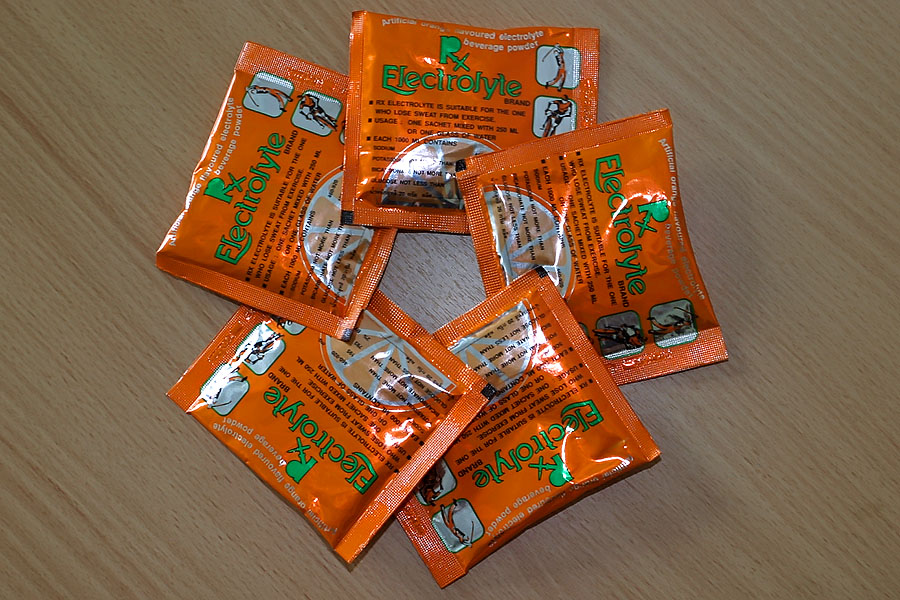
Sachets of electrolyte powder
It's not a bad idea either to add an electrolyte to the water occasionally to replace body salts lost through sweat. If you get an upset tummy and lose even more body fluid because of diarrhoea then electrolytes are even more important as you begin the process of rehydrating your body. Small sachets of orange-flavoured electrolyte powder are available at all pharmacies and cost about Bt5 each. They are a lot cheap if you buy the whole box.
Tap water in certain parts of Thailand is drinkable, supposedly, but I never drink straight from the tap. At home I run water through a carbon/resin/ceramic filter before drinking it or drink bottled water.
I have been reliably informed that water at room temperature is better for the body. At restaurants I prefer bottled water but it is common to be given water from a jug on the table. This water is fine. Ice is best avoided. Ice cold drinks going into a hot body can upset the system, the water source of the ice can be suspicious and I have seen a few ice-making facilities in Thailand. Huge blocks of ice are dragged across filthy pavements before being cut up or fed into machines to produce ice-shavings.
I don't like getting bitten by mosquitoes, but mosquitoes are everywhere in Thailand. The bites irritate and there are some very nasty mosquito-borne diseases. Malaria is still a big killer in the world today killing an African child every 30 seconds. In most parts of Thailand malaria isn't a problem, but Dengue fever is. It's not as serious as malaria, but neither is it very pleasant.
A recurrence of Dengue can result in Dengue Haemorrhaging Fever which can be fatal. Try to find out beforehand if these diseases are present in the place you are going to. Mosquitoes carrying malaria bite at dusk and dawn but the Aedes mosquito that carries Dengue bites during the day. These stripy mosquitoes also like to live near to humans.
If you thought that Dengue is something that exists only in remote jungle regions that isn't true. In the Bangkok area between 1st January and 21st March 2005 a total of 667 people were infected with Dengue. Most lived in the Bang Kho Laem, Chatuchak, Lat Phrao, Yannawa, Chom Thong, Rat Burana, Nong Chok and Bang Khen districts (source 'The Nation' 23rd March 2005). It's still a big problem where I live in Hat Yai.
If you notice mosquitoes, cover up and use repellents containing Deet to prevent bites. Prevention is better than cure. 7-Eleven stores in Thailand sell small sachets that contain a cloth impregnated with Deet mosquito repellent. They are cheap (Bt5) and convenient. Instead of carry a bottle of repellent around you just wipe the cloth over your skin and throw it away. 7-Eleven stores can be found absolutely everywhere in Thailand.
Hepatitis is a problem in Thailand. An American down-and-out bum I ran into on the streets of Bangkok who was scrounging money from foreign tourists told me this and provided me with some invaluable (and unforgettable) advice. "Don't eat any bad pussy," he told me. Depending on the type of Hepatitis, it can be contracted in different ways. It's easy to take care of your own personal hygiene but not so easy to ensure the personal hygiene of the guy cooking your lunch. Be aware of what you eat and where you are eating.
Rabies is endemic in Southeast Asia. I declined rabies shots before I left England as I didn't anticipate a problem with rabid dogs but then got bitten by a monkey in Langkawi. I lived to tell the tale but it's something else to watch out for. I was attacked by a wild cat that got into my house in 2014 and then had a course of rabies shots.
Vaccinations are available for most of these diseases either in your home country or once in Thailand. Elsewhere on this site is information on some travel related diseases.
Sexual health is another big problem in Thailand, and Thailand is one of the world's primary destinations for sex tourism. Precautions should be taken if you plan to participate in Thailand's infamous nightlife scene. Even if the disease you catch won't kill you, it may leave you with a very unpleasant, permanent reminder of your vacation in Thailand.
If you research about health matters in Thailand it may put you off visiting altogether. However, most visitors are fine. The biggest danger to life in Thailand is on Thailand's roads.
Healthcare In Thailand
My introduction was all rather bad news, but the good news is that Thailand has an excellent healthcare system with excellent facilities and a lot of excellent doctors and nurses.
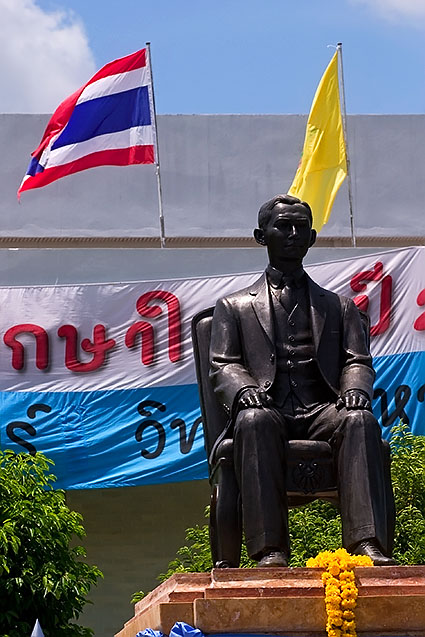
Prince Madidol Adulyadej of Songkhla, the Father of Thai Public Health
I watched a video about an American who went to Thailand for a medical procedure. Before he went he imagined that there would be chickens running around the hospital. When he arrived he was amazed to see the first class medical facilities that exist in Thailand.
The system of medicine that is practised is mainly Western, but you will also find plenty of Thai and Chinese traditional medicine in the country. In fact, hospitals in Thailand now have to devote a certain percentage of their budget to traditional medicine.
1828 was the first year in which Western medicine began to play a role in Thailand. The system now is a holistic approach using the best of Eastern and Western medicine. The newest faculty at the university where I used to teach is for Thai traditional medicine and this coexists alongside faculties teaching Western medicine.
During King Rama V's reign a sanitation law was enacted in 1870 to clean up rivers and canals, and Siriraj hospital was opened. This hospital has lots of royal connections and contains some of the most amazing medical museums which all visitors to Bangkok should make an effort to visit.
In 1888 a Nursing Department was established at Siriraj. During the reign of King Rama VI a Public Health Department was established (1918). In 1942, during the reign of King Rama VIII, the Ministry of Public Health was set up.
One of the key individuals responsible for many reforms and improvements to the health system was the King's father, His Royal Highness Prince Madidol Adulyadej of Songkhla (the 69th son of King Chulalongkorn - King Rama V).
In 1992, on the occasion of the 100th anniversary of his birth, royal permission was sought to rename him Prince Madihol 'The Father of Thai Public Health.' Several individuals within Thailand's royal family continue to be very active supporting healthcare initiatives in Thailand.
Good healthcare is a right of the Thai people and has been written into the Thai constitution, "The state shall thoroughly provide and promote standards and efficient public health services." Thailand is a wonderful example to the world of what can be achieved when a healthcare system is set up for the right reasons and not purely as a profit-generating business.
Healthcare Tiers
As in many other countries, there are different tiers of healthcare.
- Public Hospitals
- Private Hospitals
- Private Clinics
Public hospitals are where the rural masses go for their free healthcare. They are normally very busy places and can look extremely chaotic. The nurses are overworked, the hospitals are crowded, and you will often see beds in corridors because the wards are full. However, they do what they are supposed to do. Their appearance can also be quite deceiving.
When my son was born with pneumonia he stayed in an NICU ward at a public hospital for three weeks. The hospital is located in a real Third World area and looks terrible from the outside, however, the NICU ward is state-of-the-art and has first-class doctors and nurses.
Some larger public hospitals are also attached to universities in Thailand and have excellent research and laboratory facilities, which even the best private hospitals don't have.
Most doctors that work in private hospitals in Thailand do so on a part-time basis and have regular jobs at public hospitals. Therefore, the doctors are the same wherever you see them.
Some public hospitals have added fancy wards that resemble private hospitals. These are free for Thai government employees, but there is an additional fee for everyone else.
Foreigners can use public hospitals, but if you can't speak or read Thai and have no one to help you it is not an easy process. Public hospitals are intended for Thais and they don't employ special staff whose job it is to help foreigners.
Most private hospitals in Thailand resemble hotels, and some even resemble five star hotels. They are quite impressive edifices.
The healthcare is fine, but they are private businesses and - of course - they are primarily profit centres. These places are keen to promote medical tourism and they want to attract 'rich' foreign patients.
As you enter you will be greeted by pretty English-speaking Thai girls whose job it is to make the process of seeing a doctor as easy as possible for foreigners. The facilities are excellent and the nursing care very attentive, but the doctors are the same people who work in the public hospitals.
I may sound a little cynical, but if I need to stay in hospital in Thailand I go to a private hospital where there are private rooms and a bit more dignity. I buy medical insurance to cover the cost.
Even though private hospitals in Thailand are expensive for Thais, they are still very cheap when compared to other countries.
We have already established that the same doctors work in public and private hospitals. Many of these doctors also run private clinics out of hours in the evenings and at weekends. You see the same doctors in slightly different surroundings, and without the overheads of running a large hospital it is cheaper to see a doctor at his or her clinic.
Knowing where to go requires some local knowledge and, again, it helps to be able to speak and read some Thai to locate the right clinic.
My daughter sees a doctor at one of Thailand's biggest and best public hospitals, I use private hospitals if I need to be admitted or for things that my insurance will cover, and I also use private clinics.
If you know nothing about Thailand and money isn't an object, or if you have medical insurance, just go to the nearest private hospital and let the pretty girls help you.
If money is limited and you know nothing about Thailand you really need a Thai person to help you, whether you go to a public hospital or want to find a private clinic.
The private hospitals are great for foreigners who can't speak or read Thai and who have no local knowledge. With the other options you need some language skills and local knowledge, or a Thai friend to guide you through the process.
Bird Flu
Every now and again there is a huge amount of scaremongering about the latest virus. Bad news sells, and thus bad news brings in more money. There is nothing that news organisations love more than the threat of a pandemic that has the potential to wipe out mankind.
SARS, AIDS, Bird Flu, West Nile Virus, Ebola, etc etc. These things always fizzle out quietly after a while without any news coverage of their demise, but while they are active the media blows them up out of all proportion.
The BBC is one of the worst culprits for scaremongering and overhyping this type of story. In the past I have complained, only to be told they have consulted experts in the field and base their stories on expert opinion.
This is rubbish. They are only interested in their TV ratings and the number of visitors that visit their web site.
Statistically, these viruses kill so few people that there is a lower risk of contracting the disease than winning the lottery. The reality in Thailand is that you face a far greater risk of being injured in a road accident than being struck down by Bird Flu.
Medical Insurance
Any form of insurance which isn't mandatory is a gamble. When you buy a policy it may save you money or you may have a trouble-free year and not make a claim, in which case it might possible seem unnecessary.
Since I started buying medical insurance in Thailand, the insurance has probably cost me more than saved medical bills, but it gives me peace of mind and you cannot put a price on peace of mind.
Whether you opt for insurance or not is a personal decision. There are lots of diseases in Thailand and the way that Thais drive terrifies me. I feel happier having insurance while living in Thailand. It's your decision.
In Thailand it is necessary to go to one of the large foreign insurance companies operating in Thailand such as AXA, AIA or Bupa to buy medical insurance. Policy prices are based on a combination of age and benefits. People aged 10-19 are considered the lowest health risk and those aged 61-65 the highest. If you already have a policy they will often continue giving you cover over the age of 65, but if you apply for the first time aged over 65 you may have some problems.
The AXA healthcare policies are divided into age ranges and each age range has five tiers of cover offering varying degrees of financial cover.
The age ranges are 6 months to 9 years, 10-19, 20-29, 30-35, 36-40, 41-45, 46-50, 51-55, 56-59, 60-65.
You will need to check with the insurance company, but in 2014 my policy for IPD level 2 for the 51-55 age range was around Bt11,000. If you're between 60 and 65 and want Level 5 coverage then it will be a lot more expensive. Conversely, it will be a lot cheaper for teenagers who only want Level 1.
I also had OPD cover for several years, but decided to drop it. OPD insurance cover is quite expensive and my policy had a limit of Bt1,000 per visit. For this insurance to be effective it meant about one hospital OPD visit per month and I never visit the hospital every month.
For my policy a medical check was not required but there was a form to fill out and failure to disclose previous conditions will void the policy.
One more thing to mention is that I was asked for a copy of my work permit by the insurance company. I'm not sure why.I can't understand why they wanted to see a work permit and I don't know what the response would have been if I didn't have one.
Recommended Adult Immunisations For Thailand
The Nation published an excellent article about immunisation for adults in their 17th November 2004 edition. The following information is taken directly from that article. This information should only be used as a guide. Always consult a professional for up to date medical advice.
The gist of the article is that we are all aware immunising our children is important but have we neglected to keep our own shots up to date? It was written by staff from the Queen Saovabha Memorial Institute on Rama IV Road in Bangkok and is specifically for Thailand.
Generally everything on my web site has been written by myself but this was so good, and I'm sure the advice will be appreciated by others, it seemed a shame just to keep the newspaper article in my desk drawer and not make the information more widely available.
Measles: A viral disease present in Asia, infection is via the air. If you are uncertain whether you received a full course of live measles vaccine as a child and are travelling extensively or are a healthcare worker, teacher or social worker, consider getting a booster dose.
Mumps: Endemic worldwide.The indications for a booster dose are the same as measles.
German Measles (Rubella): This relatively mild disease, spread by respiratory secretions, can cause severe foetal malformations during pregnancy. All young women should review their childhood vaccine history and make sure they have immunity prior to getting pregnant. If in doubt, get a booster dose before planning pregnancy.
Polio: Thailand has been polio free for many years but imported cases do occur.A booster dose should be considered when travelling to endemic countries (India, Nepal, Africa). There is an injectable polio vaccine which can be safely given during pregnancy.
Tetanus and diphtheria: Tetanus bacteria are found in the soil worldwide. The current tetanus vaccine induces long-lasting immunity but you should have a booster dose at 10-year intervals.Diphtheria is spread via inhalation. It can be deadly and a vaccine is given in a joint product with tetanus called TD. Thailand has only occasional cases of diphtheria but outbreaks have occurred in central Asian countries.
Hepatitis A: This form of acute liver inflammation is spread by contaminated water and food as well as by some sexual activities. It is still common throughout Asia. Hepatitis A vaccine is available in Thailand.
Hepatitis B: This is spread by blood, body fluids, dirty syringes, from mother to infant and by sexual activities. It is endemic in Asia and can become chronic with severe liver damage, including cancer. It is preventable by vaccines that are now routinely given to all infants in Thailand.
Hepatitis C and E: Hepatitis C is common worldwide. It is spread like B. There is no vaccine for this disease, which can become chronic. Hepatitis E is food and water spread, relatively uncommon in Thailand and similar to A, but can be dangerous in pregnancy. There is as yet no vaccine.
Influenza: Influenza is transmitted by air and is present worldwide. It can be a fatal disease in small children, the aged, persons with immune deficiency and chronic lung diseases. The virus causing influenza is capable of rapidly changing its "mantle" and protection requires a newly-made vaccine every year.
Chicken Pox: Chicken pox or varicella is widespread in Asia and is usually serious in adults. Once infected, it remains with the person and may later reactivate and cause shingles.This is a reason why vaccination is a good idea.
Pneumococcal vaccine: This vaccine decreases the risk of pneumonia and meningitis due to streprococcus pneumonia. It is a deadly disease spread by inhalation in the very young and aged. The vaccine is now recommended for individuals over 65 years and those with chronic disease.
Meningococcus meningitis: This type of meningitis (inflammation of the brain cover) is spread by inhalation and is not common in Thailand. Routine immunisation is not recommended. It is, however, endemic in northern India, Nepal and much of Africa.Pilgrims going to Mecca are required to take the vaccine.
Japanese encephalitis: This disease is spread by mosquitoes. The natural hosts are pigs and birds. It is common throughout Asia and parts of northern Australia. The virus starts with mild flu-like symptoms in most but can cause a severe, often fatal, form of brain inflammation. Vaccination is recommended for children living in rural Thailand and consists of two doses, two to four weeks apart with a booster a year later.Adults without prior vaccination should be given three injections, one week apart.
Rabies: Rabies in Thailand is predominantly a disease transmitted by dogs and cats. Human rabies is fatal but can be prevented by pre- and post-exposure vaccination. These vaccines are available in Thailand. It is important to remember that any mammal bite can transmit rabies.Immediate washing of the wound with water and evaluation at a hospital are essential preventive measures.
Tuberculosis vaccine (BCG): This vaccine is given to all infants born in Thailand but it does not prevent the disease later on in life.
Other vaccines: Yellow fever vaccine is mandatory only for travellers to parts of Africa and South America. The disease is not present in Asia. The vaccine is available at several WHO-certified government facilities in Bangkok, Chiang Mai and Songkhla.
Moderately effective typhoid fever vaccines are locally available and should be considered by travellers to countries with poor food hygiene. Cholera vaccines are available and may be considered by travellers to Saudi Arabia, Bangladesh, India and Africa. They are of only transient value and cholera is best prevented by attention to food hygiene. Tick-borne typhus vaccine is recommended for travellers to parts of central and eastern Europe and the central Asian countries if they plan extensive outdoor activities. It is not available in Thailand but can be obtained in Europe and Russia.
Plague and anthrax vaccines are of marginal efficacy and indicated only in special situations (occupational exposure or under the threat of bio warfare). We do not yet have any vaccines against dengue fever, malaria, leptospirosis, scrub and murine typhus, liver flukes, fillarisis, meliodosis and HIV/Aids.Much research is going on but only a dengue and perhaps malaria vaccine looks promising so far.
Adverse effects of vaccination: Any vaccine, like antibiotics and most drugs, can cause side effects. Discomfort, swelling and redness at injection sites as well as a mild fever, headache and muscle pains are among such reactions. They are almost always transient. If you have had such a reaction before, mention it when reporting for immunisation.
Start by asking your doctor to review your immunisation status and determine your special needs. Check the following web site for more information:
Vaccines are available at most hospitals.Several private hospitals in Thailand maintain specialised travel and immunisation clinics.
The Queen Saovabha Memorial Institute of the Thai Red Cross Society on Rama IV Road provides most vaccines and specialises in managing animal bites. Yellow fever vaccine is available at the Immigration Department on Sathorn Road (Tel. 02 286 5114) and the Bureau of Communicable Disease, Ministry of Public Health on Tiwanon Road in Nonthaburi (Tel. 02 591 8393).
Recommended adult immunisations adapted for Thailand
Tetanus and diphtheria: 1 booster every 10 years
Influenza: 1 dose annually*
Pneumococcus: 1 dose*
Hepatitis B: 3 doses (0, 1, 6 months)
Hepatitis A: 2 doses (0, 6 months)
MMR: 1 dose**
Varicella: 2 doses (0, 4 weeks)**
Pertussis: 1 dose**
Meningococcus: 1 dose***
Japanese encephalitis: 3 doses (0, 7, 21 days)***
Rabies: 3 doses (0, 7, 21 days)***
* Persons over age 65 years and chronically ill
** 'Catch up' on childhood vaccination (health care workers, teachers, etc.)
*** For persons with lifestyle, occupational or travel exposure risks
Eyes And Contact Lenses
I contracted a bad fungal infection in one eye through a soft contact lens in 2004 and it caused a permanent problem with irregular astigmatism. The first doctor I saw assumed it was a bacterial infection.
After antibiotic drops had no effect the problem became 'complicated' according to the doctors. It's a long story but to keep the details brief I saw seven doctors (five in Thailand and two in Singapore). At various stages the infection was diagnosed as bacterial or fungal. At other times it was suspected of being a virus or Acanthamoeba. The latter is particularly nasty and potentially blinding.
I had four of the worst months of my life with blurred vision, an almost constant feeling that a large grain of sand was in my eye and extreme sensitivity to light. Going outside was not an option for many months so I was confined to my own darkened room like a virtual prisoner. The medication was hardly any better, especially the anti-fungal drops which stung like hell. At one point with none of the medication working the doctor mentioned that a corneal transplant might be necessary. This news gave me anxiety fears on top of the physical pain.
My condition reached a stage where the medication was making things worse rather than better. Putting toxic anti-fungal drops in my eye every hour during the day and every two hours at night was doing me no good at all. The doctor told me to stop the medication and slowly things started to improve. My eye got better but it was never the same again.
The infection left a big scar on my cornea and as the healing process began it started to change the shape of my cornea. This, in turn, caused bad astigmatism. I now have to wear new glasses to correct the astigmatism and I no longer have the perfect near-sight I used to have for reading and computer work.
The moral of this story is that if you wear contact lenses be especially vigilant about cleaning them. If you wear weekly or monthly disposable lenses change them on time. Although it works out more expensive, one day lenses which are just thrown away at the end of the day are a safer bet.
Do not shower or swim wearing contact lenses. Acanthamoeba lives quite happily in sea and tap water. If the parasite gets trapped behind a contact lens it can then enter your eye. Make sure you always clean your hands before handling lenses and follow the lens cleaning solution manufacturer's instructions to the letter.
After wearing lenses for a long time I had got a bit complacent after never having a problem. However, in the year-round heat and humidity of Thailand, bacteria, viruses, fungus, parasites and other micro organisms thrive. If you are a lens wearer be very careful. One of doctors I saw in Singapore recommended that I never wear lenses again. At first I was upset about this but now I am happy just to wear glasses. I never want to go through anything like that ever again.
Considering what I went through and how I could have been blinded, it amazes me to see so many young Thai girls with perfect eyesight who elect to wear cosmetic contact lenses to give them the 'Big Eye' look. They must be mad.
Is It Necessary To Bring Lots Of Medication?
Obviously if you need special prescription drugs you should bring those. Otherwise, it's whatever makes you feel most comfortable. If you feel better about having a well-stocked medicine kit in your bag bring it. Personally, I wouldn't bother unless going into a very remote area. There are pharmacies everywhere in Thailand, many with excellent pharmacists. I have never found it a problem getting a good diagnosis and suitable medication for any problem I've had in Thailand.
Local pharmacists understand most ailments and are well equipped to deal with the things that are likely to be a problem in Thailand. Medication is cheaper in Thailand compared to the West and there are drugs available over-the-counter that are not available over-the-counter in the West.
Thai Traditional Medicine
Though not suitable for everything, the different kinds of Thai traditional medicine may be able to treat certain ailments and diseases. The term 'Thai massage' has a certain reputation among many foreigners, but it was originally developed as a form of treatment rather than something to relax and/or stimulate foreign tourists.

Young masseuse in a Thai massage shop working on my legs
Thai herbal medicine is also widely used in the country, especially in rural areas. Some of the herbs are quite potent, but because they are naturally they don't cause side-effects.
Foot massage should be a kind of reflexology session but the majority of practitioners doing it don't understand much about reflex points. They normally use a balm which gives a warm sensation, like 'Vick' or 'Tiger Balm'. After applying the balm they will wrap your feet and lower legs in a towel. After a few minutes a pleasing, warm sensation will be felt. The massage consists of rubbing and applying pressure to the feet and toes with the fingers and a wooden stick. Depending on the sensitivity of your feet it can be very painful.
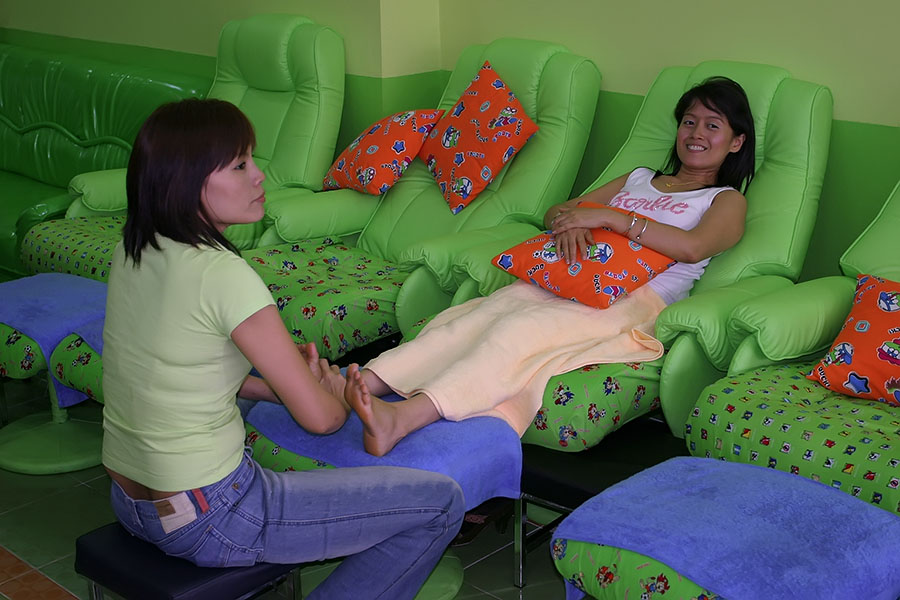
Foot massage is particularly popular with ethnic Chinese visitors to Thailand
A properly trained reflexologist will keep an eye on your facial expressions when applying pressure to the feet. If they see you grimace in pain this will be an indication of a problem in the body and the reflexologist should be able to tell you which part of the body is causing the problem.I have been amazed in the past how a properly trained person can detect problems in other parts of my body from reflex points in my feet. The 'tourist area' foot masseuse won't be able to though, despite all the fancy anatomical drawing and reflex charts hanging up on the wall. A session might last an hour and cost Bt250.
Chinese Medicine
Thailand has a large Chinese population and there are lots of pharmacies and doctors specialising in Chinese medicine. The pharmacies are easily recognised by the strange items they stock - roots, herbs, tree bark, animal parts, etc. The smell inside a Chinese pharmacy is actually very pleasant. I have watched fascinated as the pharmacist prepares prescriptions using a set of scales to mix weird and wonderful ingredients before wrapping them up in pieces of plain paper.

Chinese medicine shop in Trang
My view of Eastern medicine is that it definitely has a place alongside Western medicine. Western medicine is quite destructive. Western doctors make a diagnosis and then prescribe something to kill the problem but what else does the medicine destroy? Eastern medicine takes a more holistic approach where balance is very important and the whole body is looked at. Something out of balance in one part of the body may be causing problems elsewhere. As a visitor to this site wrote and told me, Chinese medicine has been around for 6,000 years so they must know a thing or two by now.

Chinese medicine
I once went to a Chinese pharmacy in Penang to get something for an excruciatingly painful sore throat. I was hoping I would get a strange 6,000 year old remedy consisting of weird ingredients. Instead the pharmacist sold me a pack of Strepsils.
In desperation I went to see a Chinese doctor about my eye infection (see above). It was a strange experience. I was told by the pharmacist who recommended him not to say anything. I wasn't to ask any questions or start giving him the history of my eye problem.
His shop was unlike any doctor's surgery I had ever been to. There was no reception desk - no other staff in fact, it was just him. The place was filthy, his desk was cluttered, he chain-smoked throughout my consultation and occasionally used a spittoon on the floor to his right.
He asked me a few basic questions - where I came from and what I did for a living - but didn't speak much. His entire diagnosis was performed just by feeling the pulse on both of my wrists. From this he is apparently able to determine any problem in the body.

Chinese medicine
He wrote out my prescription using an old-fashioned ink pen and a pot of black ink. It was all in Chinese characters of course. I went back to the pharmacy to have it made up. The cost rather startled me. The prescription was for six days and he had included double doses of Ginseng each day which doesn't come cheap.
Each morning I had to boil the herbs up like tea and drink the resulting liquid. The Ginseng was soaked in the 'tea', chewed and swallowed. I had to keep the herbs and later in the evening added three more cups of water to repeat the process.
Did it work, then? I'm afraid I can't answer that question. My eye definitely started to improve but I think this had more to do with the fact I stopped putting toxic drops into my eye at the same time I started taking the Chinese medicine. The Chinese medicine was designed to give my nervous and immune systems a boost and I'm sure it didn't do me any harm but how much actual good it did me I cannot be sure.