
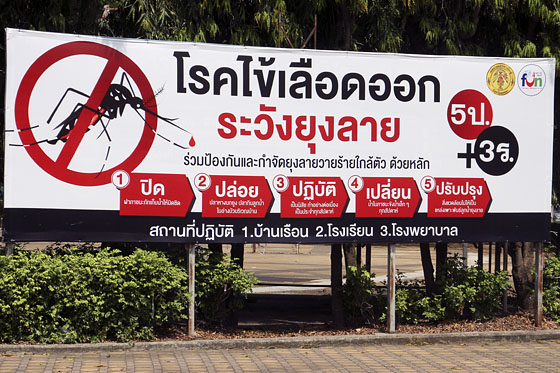
Dengue Fever | Symptoms, Treatment, Vaccines
What is Dengue Fever?
Of all the tropical diseases that exist where I live in Southeast Asia, this is the one that I have the greatest risk of contracting. I have heard about lots of infections, including the children of neighbours and kids who attend the same school as my children.
It is a mosquito-borne virus common in tropical countries.
There is no cure, as such, but hospital treatment in most cases is very effective. In Thailand if you see a doctor with flu-like symptoms the doctor will often perform a blood test to check for Dengue. This is one of the reasons why you should see a local doctor if you become ill in the tropics and not wait until you get home.
Now only will the disease become more advanced if you wait, but your doctor at home probably won't start doing tests for tropical diseases.
In some cases Dengue Fever can develop into Dengue Hemorrhagic Fever (DHF) and this can be fatal.
What Are The Symptoms?
Dengue Fever results in flu-like systems with a fever, headache, muscle and joint pain. The old name for Dengue Fever was 'Breakbone Fever', which gives an indication of how severe muscle and joint pain can be.
How Is It Contracted?
It is contracted from the bite of an Aedes mosquito. This particular type of mosquito has black and white stripes on its body and legs and is noticeably different in appearance to regular mosquitoes. Thais refer to this type of mosquito as 'yuung laay', which basically translates as 'stripy mosquito'.
Whereas regular mosquitoes are active from dusk to dawn, stripy mosquitoes are active during the daytime. I often find myself under attack when gardening or working outside. They are also quite aggressive and will chase their targets.
Who Is At Most Risk?
Anyone who lives or visits a country in which Dengue Fever is present is at risk, but the disease can be particularly dangerous when young children are infected.
Where Are You At Risk?
Dengue Fever is now almost a global problem and is present in over 100 countries. India and Southeast Asia appear to be the worst affected regions, but it is also a problem in Latin America and Africa.
A country's wealth has no bearing and there are frequent outbreaks in Singapore, which is one of the most advanced nations in the world. It is more prevalent in urban and semi-urban areas, rather than rural areas.
Vaccination
A year or two ago at one of my local private hospitals in Thailand I saw a poster with information about a Dengue vaccine called Dengvaxia. However, it was only available for people aged 9 to 45. I was interested, but my children were too young and I was too old.
In December 2017 I then read that the vaccine had been suspended in the Philippines bacause in some cases it worsens the disease if the patient hasn't previously contracted Dengue.
This is the problem with vaccines. They can be very good, but sometimes they can make the situation worse.
Source Of information
GlaxoSmithKline, Wikipedia, local doctors, local hospitals, newspaper articles, various.