
Learn How To Read Thai - Tutorial 15
'T' Consonants
In the process of learning to read Thai, there are different things to do. At this early stage it is important to try to remember the Thai characters and what sounds they make.
This tutorial is to show you the different 't' sound consonants and I added some information about Thai names.
As we saw in Tutorial 5, there are several characters that make a 'K' sound and in Tutorial 10 we saw that there are four Thai consonants that make an 'S' sound. It will not surprise you then that there are several Thai consonants that make a 'T' sound.
As is always the case though, usage varies considerably. You will see a couple of these characters all the time - and one occasionally - but you can live in Thailand a long time and never see the other three. Put your energy into learning the commonly used characters and don't worry too much about the others.
Try to learn and remember the common 't' sound consonants as you will need them later when we do more reading practice.
ท
Name in Thai: ท ทหาร
Name in English: Tor Tuh-haan (soldier)
Initial: t
Final: t
Class: Low
Usage: Very common
Writing practice: Download Worksheet
Comments: This is the most commonly used 't' consonant and you see it all the time. All of the 't' consonants retain the same sound whether used as an initial or final consonant.
ถ
Name in Thai: ถ ถุง
Name in English: Tor Tuung (bag)
Initial: t
Final: t
Class: High
Usage: Fairly common
Writing practice: Download Worksheet
Comments: I have no statistics but I guess this is the second most common 't' consonant.
ธ
Name in Thai: ธ ธง
Name in English: Tor Tong (flag)
Initial: t
Final: t
Class: Low
Usage: Fairly rare
Writing practice: Download Worksheet
Comments: Not used as often as the consonants above, but used more than the consonants below. This consonant seems to be reserved for special words that are related to nation, religion, monarchy.
ฑ
Name in Thai: ฑ นางมณโฑ
Name in English: Tor Naang Mon Toh (a Thai Queen)
Initial: t
Final: t
Class: Low
Usage: Very rare
Writing practice: Download Worksheet
Comments: Some Thai consonants are so rare that I hardly ever see them and can't remember how to write them. This is an example. For the beginner, be aware that these rare characters exist but concentrate on the commonly used consonants.
ฒ
Name in Thai: ฒ ผู้เฒ่า
Name in English: Tor Poo Tao (old man)
Initial: t
Final: t
Class: Low
Usage: Very rare
Writing practice: Download Worksheet
Comments: I only know one expression that uses this letter and it's one that my Thai female friends use a lot for me. The Thai idiom tao hoo-uh ngoo (old man snake-head) is the equivalent to 'Dirty Old Man' in English. It didn't take them long to suss me out.
ฐ
Name in Thai: ฐ ฐาน
Name in English: Tor Taan (base)
Initial: t
Final: t
Class: High
Usage: Very rare
Writing practice: Download Worksheet
Comments: I see this consonant very rarely. It's virtually obsolete but it isn't obsolete. If you can't remember, don't worry. I can't remember how to write it but I never need to write it.
Thai Names
Surnames are still a relatively new concept in Thailand; a surname has only been legally required since 1913. Even today, surnames are only used on official forms and rarely surface in everyday life. Thais generally just use nicknames, or official first names (real names) when they are being more formal.
They also find it incredibly rude not to use some form of address or salutation before someone's name. For example, Somchai would never be addressed simply as Somchai. He might be addressed as Khun Somchai, or Pee Somchai by those who are junior in rank to him or younger than him.
It sounds quaint when Thais address John Smith from England who is on vacation in Thailand as Mr John, but this is simply what they do among themselves. The Smith surname is forgotten about and the salutation Mr is the English equivalent of Khun.
It even applies to children. Informally, children are refered to as 'Nong' because they are younger, followed by their nickname - in the case of one of my daughter's classmates, 'Nong Perfect'.
Formally, they are addressed as 'Dek Chaay' (boy child) or 'Dek Ying' (girl child) followed by their official Thai 'real name'. Thus, a couple of examples would be Dek Chaay Somchai (a boy) or Dek Ying Supaporn (a girl). Again, a surname is not regarded as being very necessary.
Hierarchy is very important in Thai society and anyone older must be referred to as 'Pee'. My wife is the youngest of eight, therefore her siblings are all 'Pees' and most of her friends are older so they are also addressed with the 'Pee' salutation. Invariably, my wife refers to almost everyone as Pee.
Interestingly, Thais will often write this using the English letter 'P' with an apostrophe. My wife's phone address book is full of names written in English that begin with P', for example, P'Nok, P'Poo' P'Pla, P'Kai, etc etc.
Status is also incredibly important in Thailand and people will get upset if they aren't addressed with an appropriate title. Teachers are addressed as 'Kroo' and university lecturers as 'Ajarn'. Many young foreigners arriving in Thailand to bum around for a while and fund their travels by teaching English like to use the 'Ajarn' form of address, but they aren't entitled to it.
Tradesmen in Thailand are referred to as 'Chaang' (a different tone to the word for elephant) and 'Chaang' can also prefix their nickname of first name as a form of address. 'Chaang Dum' (without a 'b') did some work on my house when it was being built.
Doctors are called 'Mor' or 'Pairt' and Thais also consider it important to specify a gender, which isn't the case in Western countries. Male doctors in Thailand are referred to as 'Naay Pairt' and female doctors as 'Pairt Ying' or 'Naay Pairt Ying'.
As in English, titles are often abbreviated. Just as doctor would be written Dr in English, Thai also uses abbreviations.
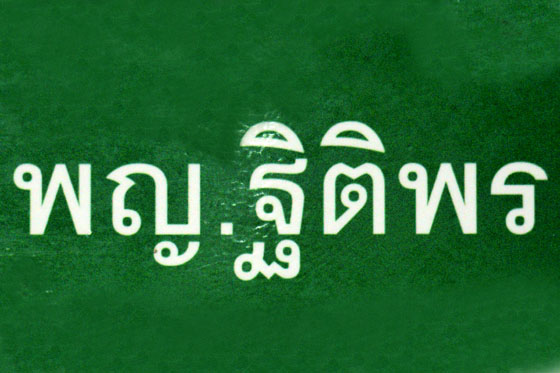
Can you read these two signs? One is for a male doctor and one for a female doctor. One name also uses the rare 'T' consonant that I covered above.

How did you get on?
The top one is for a female doctor referred to as 'Pairt Ying Tittyporn'. The bottom one is for a male doctor referred to as 'Naay Pairt Narongsuk'.
Vocabulary
Here's some vocabulary related to names and titles.
ชื่อจริง - cheu jing (real name)
ชื่อเล่น - cheu len (nickname, literally 'play name')
นามสกฺล - naam sa-guun (family name, surname)
ชื่อสกฺล - cheu sa-guun (family name, surname)
เด็กชาย - dek chaay (boy child)
เด็กหญิง - dek ying (girl child)
ช่าง - chaang - falling tone (tradesman)
ช้าง - chaang - high tone (elephant)
น้อง - nong - high tone (younger person)
พิ่ - pee - falling tone (older person)
ผิ - pee - rising tone (ghost - terrifies Thais)
ครู - kroo - mid tone (teacher)
อาจารย์ - aajarn (professor, lecturer)
Reading Practice
Reading practice is good because it is the only real way to monitor progress. Using real-world signs is essential because the fonts you see on signs are completely different to the fonts used in books and on websites.

คิง แทททู
In this sign there are three instances of the commonest 't' consonant. The first word starts with 'kor kwaay', there is an 'i' vowel written above and the final consonant is 'ngor ngoo'. Words like this transliterate quite accurately - the word is 'king'.
The first syllable of the second word has a 't' initial consonant and a 't' final consonant with an 'air' in the middle (written before the initial consonant), so the sound is a kind of 'tairt' sound.
The second syllable has a 't' initial consonant and is followed by the long 'oo' vowel. There is no final consonant, therefore it is 'too'.
'Tairt too' is the Thai transliteration of 'tattoo'. Tattos are very popular with many Westerners who visit Thailand.
Questions And Feedback
If you have any comments, questions or suggestions, feel free to contact me. Your feedback will help me to improve these pages.
Recommended Books
Amazon UK
Amazon UK
Amazon US
Amazon US