

Thailand - Climate
The Thai Language
Like many visitors to Thailand I didn't bother learning any of the language when I first started coming to Thailand. To be honest, in the main tourist areas you can survive just fine without knowing a word and even if you do learn some Thai, the Thais in heavily touristed areas like Phuket will still speak far better English than you speak Thai.
Tourists will inevitably pick up the words for 'hello' and 'thank you' soon enough and the more adventurous ones may even learn how to ask the price of things and ask for their restaurant bill in Thai.

Floating market at Damnoen Saduak, Thailand
Learning a little more though can be extremely useful and it's not that difficult. Just learning how to count is a good thing and can be learnt easily in a couple of hours. Some of the more unscrupulous Thais will try it on with foreign tourists and if you can pick out numbers you can sometimes work out how much they are trying to rip you off by.
When negotiating prices, if you can do it in Thai it gives the impression that you have been around a bit and are not quite as gullible as they think. Con artists in Thailand prefer targeting first time visitors who are still wet behind the ears and knowing a few Thai words gives the impression you know the ropes, even if you are a first time visitor.
Apart from the cynical reasons there are practical reasons too. If you stray a little from the beaten tourist path you will almost certainly meet Thais who don't speak any English. I don't know what the statistics are but there are a lot more Thais who can't speak any English compared to those who can, especially in the older generation.
Being able to speak a few words is really appreciated by non-English speaking Thais and if you want to buy something or get some information it is invaluable. Besides, it's nice just to be able to say hello and offer some small talk instead of just smiling like a dumb tourist.

Thais in a pickup truck
If you are interested in what Thais really think of foreigners the only way is to understand what they are saying among themselves. I am amazed at times and I can only understand a little. The first thing that surprises me is that almost all Thais assume farang tourists cannot understand one word of Thai. They are probably right with about 99% of tourists but don't make allowances for the other 1% and continue to talk about foreigners in their presence regardless.
Wherever I go I always hear the 'farang alert' as I approach. The first Thai to see me lets all her buddies know there is a farang approaching. I can't always make out exactly what is being said but I can pick out farang quite easily. This is the other thing that surprises me. Even if Thais know that few foreigners speak Thai, surely they must know that almost every tourist understands what a farang is? This still doesn't deter them from using the word liberally in the presence of foreigners.
Normally the interest is because the farang is a potential customer for whatever they are trying to sell and of course all farangs, without exception, are extremely rich. I have been assessed by groups of girls before who quite openly tell each other what they think of me and whether they like me or not. I don't mind this but take exception to the "mai chawp" (don't like) comments. Asking them "Tummai mai chawp?" (why don't you like?) takes them by surprise and if you're lucky you may even get one to blush.
Pitfalls Learning The Language
Thai is a tonal language. Some words are pronounced with a high, mid or low tone and others with a rising or falling tone. Thai words that may sound similar to an English speaking person have completely different meanings in Thai dependent on the tone. Phrase books use different systems to indicate the tone for each word but when attempting to pronounce a word from a phrase book it is highly likely that the Thai person will not be able to understand you. For this reason it is essential to have someone available to help you who speaks the language, preferably a native speaker.

Tourists at Thailand's famous floating market in Damnoen Saduak
Thai uses a completely different alphabet to English. This means that even if you master speaking some Thai you may still not be able to read or write anything. It also means that Thai words need to be transliterated in order for them to be written in English. There is no agreed standard for this and books vary. In fact I have not yet seen two books that use the same system. Should the Thai word for rice be written as 'khao', 'kaaw' or 'kow'? It's not so bad if you have your own system for taking down notes but if you use a variety of phrase books and dictionaries the differences between each one can be confusing.
The pronunciation of certain words is very tricky. Just as Thais have difficulty pronouncing certain English words, English speakers have difficulties with certain Thai words because certain sounds don't exist in the person's native language. Personally I find it difficult to pronounce words that begin with 'ng'. Other words require you to contort your face to get the right sound. The Thai word for friend is shown in some phrase books as 'peu-un' with a falling tone. A native English speaker might try to say this starting the word with pursed lips. However, to get the right sound I have to adopt what I think of as a wide-mouthed frog look.
For the same object or action there may be several Thai nouns or verbs based on the level of politeness. 'Taan', for instance is a polite form of the verb 'to eat' but in everyday conversation most Thais will use 'gin'. However, if they are talking to their boss at work or any superior person they will use 'taan'. This is just one example and there are many. An added problem when learning the language is learning the different words and then understanding what words to use to whom. To cap it all there is a completely different set of vocabulary used by and when speaking to the royal family. Even at the same level of politeness there may be three different words for the same thing.
In English we use classifiers for certain nouns. We ask for two bottles of milk, two cartons of milk, two pints of milk, etc., instead of simply 'two milks'. Thai uses classifiers for almost every noun and it is necessary to learn these.
Different nouns use different classifiers. There are some general rules about these, for example, certain classifiers are used for fruit and other for round objects. This means though that different classifiers could be used for an orange. Although there are some rules, for the Thai student it is a case of learning the correct classifiers to use. In all languages there are certain things that just have to be learnt.
Audio CDs and CD-ROMs for computers are OK but there is no substitute for actually having a teacher. It helps too if the teacher can speak fairly good English. At times, watching the shape of the person's mouth as they say the word is the only way of learning. I paid for a course of 10 lessons and if you are interested I have annotated by lessons into notes.
Notes From My Thai Language Lessons
So does this mean I can now speak and understand the language? Not at all. When Thais start going in full flow I normally don't understand a word but if they speak slowly I can sometimes understand a little. Apparently the folks from Chiang Mai speak slower so that might be better for me but they speak quickly in the south. I can ask some basic questions and it has been useful in remote places where people don't speak any English just knowing a few phrases and numbers. When Thais are speaking in a group I can sometimes pick out enough words to understand the subject of the conversation even if I can't understand the details.
Yet another issue is that many Thai strangers don't expect you (a farang) to be able speak any Thai so if you do it takes them a while to cotton on that you are actually attempting Thai words. When the penny drops they can sometimes then understand. It makes me feel better that in America some people cannot understand me when I speak English and I know that my English is OK even if I do have a strange East London accent.
One thing that puzzles is me here is why some Thais won't answer me in Thai if I ask a question in Thai. This happens regularly. On the bus one day was a gatoey conductor collecting the fares. I asked him how much the fare was in Thai. He tried to answer in English. The fare was Bt14 but it was impossible to understand if this was 14 or 40 because his English was not good. If he had said the Thai "sip sii" it would have been clear to me and very different to "sii sip". Another thing shopkeepers will do when you ask the price in Thai is insist on displaying the price on a calculator.
If they go to do this they must have understood the question and if you asked in Thai surely that must indicate to them that you might just understand the answer? I had this happen to me and the guy couldn't find his calculator so he spent two minutes hunting around trying to find it. I said "Just tell me!" When he did I understood perfectly and that was all I wanted to know.
Learning Thai takes effort and determination. Just living in Thailand isn't enough. I think it is quite shameful but I can understand why foreigners who have lived in Thailand for five years or more speak hardly any Thai, especially if they live in a community with lots of other expats. I have to keep forcing myself to learn more. My problem is that I have reached a basic level where I can just about get by but now I find it difficult to motivate myself to continue learning. Becoming fluent seems like such a huge mountain to climb it is easy to convince myself I will never get to that level so I become apathetic.
Phrase Books And Transliteration
Most learners attempting to learn Thai only want to learn how to speak and have no interest in learning how to read. This is an enormous mistake.
If you can't read Thai, you are forced to read Thai words that have been transliterated using the English alphabet. This practice is absolutely HORRENDOUS.
I was in a bookshop and saw a typical book written by foreigners aimed at foreigners wanting to learn Thai. On the cover was the usual garbage about how this particular book made learning Thai easy and fun.
There was also an example on the front cover. It said, 'kab rod'. An English speaker would probably pronounce this 'cab' (as in taxi) and 'rod' (as in slender pole, or the man's name). What it was actually meant to be was the Thai for 'drive a car'.
Most Thai consonants change their sound depending whether they are initial or final consonants. Also, most transliteration systems describe vowels incorrectly and pay no attention to vowel length.
If you say 'kab rod' to a Thai I guarantee that they will have no idea what you are talking about. If you say something like 'kup rote' they might.
Transliteration systems should either be phonetically correct, or they should be banned. Authors writing phrase books that use misleading transliteration should be sued for producing goods that aren't fit for the purpose they are intended for.
You might think that if you use the transliteration system from a 'reputable' organisation it will be OK. Wrong.
The Lonely Planet Thai phrase book I bought is probably the least useful, most inaccurate Thai language learning resource I have ever bought. The official Thai government transliteration system is useless, and so is Wikipedia.
I have been tempted many times to change Wikipedia entries in order to provide phonetically accurate transliteration but I know that there will be some anal person without a life somewhere who will get upset and change it straight back.
The bottom line is that if you want to learn how to speak Thai, learn how to read Thai.
Can't Understand, Won't Understand
No matter how good your Thai might be, there are many Thais who simply refuse to listen to what a foreigner are trying to say. They don't know any English and they judge other people by their own standards. As soon as they see a foreigner they have already decided that communication will be impossible so they just close their ears, avert their eyes, and ignore you.
To say this is frustrating is something of an understatement. Sometimes it makes me furious. I speak Thai at home to communicate with my wife and I use far more Thai in my everyday life than I do English. My Thai is far from perfect, but it can't be that bad otherwise I wouldn't be able to communicate at all.
I don't generally have any communication problems with those Thais who listen and make an effort to understand. I just have a problem with those who refuse to listen and refuse to understand.
If you are with a Thai and ask another Thai something, the other Thai will reply to the Thai who is with you, not to you. I have had many triangular conversations like this. Again, it is extremely frustrating.
On occasions when I want to buy something I ask the sales assistant a question, which they understand perfectly well, but the answer is always directed at my wife. I stand there thinking, "Hello, can you see me or have I turned invisible?" If nothing else, it is just plain rude.
I have told them before, "Don't speak to my wife, I'm the one with the money wanting to make a purchase, speak to me."
Interestingly, my wife always takes the Thai person's side. In other countries a wife will always support her husband, but in Thailand the Thais always stick together.
This kind of behaviour is extremely annoying, but unfortunately there isn't much you can do.
Good Things About Learning The Language
Grammatically, Thai is a lot easier than English. The different verb tenses that exist in English don't exist in Thai. Verbs stay the same and aren't conjugated. The tense is determined by the context of the sentence and additional words used in the sentence. For someone studying English, learning all of the different tenses and verb conjugations must be a nightmare.
Sentence structure is very basic and pronouns are not used very often. For a sentence such as, "What would you like to eat?", the Thai would be, "Yaak gin arai?" - literally "want eat what"? Often, when Thais speak English and sound very abrupt it is only because they are performing a word by word translation from the Thai.
In addition to making life a lot easier in Thailand, learning Thai (or learning another language in another country) has other benefits, such as protecting the brain from ageing. The following is from the BBC News Site:
"The very act of being able to speak, listen, and think in two languages and of using two languages on a daily basis appears to sharpen people's abilities to pay close attention to a aspects of tasks relevant to good performance."More here: Research to find effects on brain of bilingualism
Thai English Language Ability
Generally this is awful. It is better in the major tourist areas, and bar girls have an English vocabulary all of their own. I can count on one hand the Thai people I have met who have been able to speak fluent English. Even Thais who teach English cannot necessarily converse properly.
A Thai English teacher from Phitsanulok asked me, "Where are you come from?" When I tried to explain her error, she told me she had been taught this phrase by her Thai teacher.

Thaiglish sign

It did?
It isn't unusual to meet Thais who have been learning English for years, but who can barely speak a word.
There are several reasons for this:
- The people responsible for teaching Thai kids - Thai teachers - can't speak English very well themselves. Of course, they will have a long list of academic qualifications, and the Thai notion of 'losing face' will prevent them from admitting their inadequacies. Their bad habits simply get passed on to their students.
- The Thai education system is set up to keep kids entertained, amused and safe within their comfort zones. It is not conducive to actually learning anything.
- Most Thai students are lazy and can't be bothered to put in the hard work that is required to learn English. Despite the claim of many language institutes that English is 'fun and easy' to learn, it isn't. Once you are above the age of about six, learning a second language is extremely difficult and requires lots of hard work.
- Most Thais don't have the confidence or ability to compete with foreigners. If Thailand were to make the main language of business English it would be good for the economy but Thais wouldn't be able to compete. To allow for this, Thais are always given an advantage over foreigners in Thailand, for example, the dual pricing policy. By keeping everything in Thai it gives Thais an advantage. At the same time, this policy makes English less important to Thais, and therefore they aren't motivated to learn because it isn't necessary.
- Lots of foreigners want to live in Thailand and many are losers. The only way they can afford to survive is by 'teaching' English. Thais assume that all foreign English teachers are exactly the same. The sad consequence is that many Thai kids are taught English by foreigners who don't even understand their own language.
Regional Dialects
As in most languages, different dialects are used in different regions. Provincial Thais speak the central dialect, which is understood by all Thais, in addition to their own regional dialect.
Most Thais understand dialects from the other regions, with the exception of the southern dialect. The southern 'sing-song' dialect with its extra high-and-rising tone is completely unintelligible to Thais from outside of the southern region.
The sound of the southern dialect is quite distinct. In addition, different vocabulary is used in different regions. Also, because of the tonal nature of Thai, tones may vary from region to region.
My wife's family all speak the Thai dialect when they get together and althought I can follow conversations in the central dialect I don't have a clue what they are talking about.
If you are learning, just stick to the central dialect (paa-saa glaang) and you may want to learn some of the local dialect depending on where you are based.
I'm based in the south but haven't bothered with the southern dialect. Thai is difficult enough without adding complications, and it is unnecessary because all Thais can speak the central dialect.
The Written Language
I would imagine that learning to read Japanese or Chinese is difficult. On the other hand, learning to read Thai is relatively straightforward. Thailand has a very high rate of literacy and, to be quite honest, there are lots of Thais around who aren't the sharpest knives in the box. If they can read Thai, it can't be that difficult.
There aren't lots of complicated characters, as in Chinese. It's simply consonants and vowels. Some farangs tell me the reason they still can't read after living in Thailand for 30 years is because there are lots of consonants and vowels.
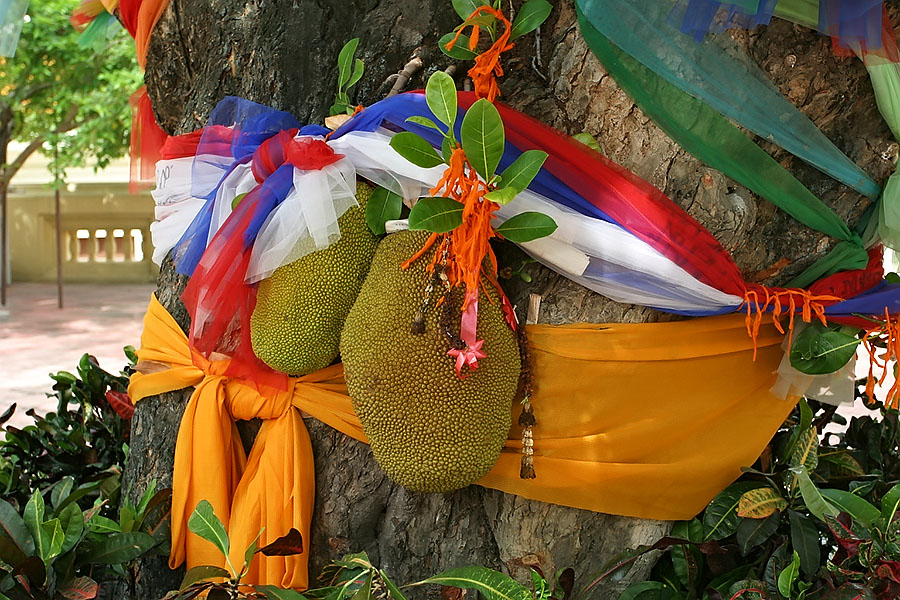
Evidence of Thailand's animist belief systems in the form of a decorated tree
That's technically true, but not really very accurate. Some consonants are obsolete and many are used only rarely. The small subset of commonly used consonants isn't actually very big.
English supposedly only has five vowels but the same vowels have different sounds depending on the word in which they are used. For example, the 'oo' in 'boot' has a different sound to the 'oo' in 'book'. Thai has two different vowels for these two different sounds. In English the words 'put' and 'but' don't rhyme. I could give thousands of other examples and the many phonetic inconsistencies in written English must be a nightmare for foreign learners of English.
Thai has a different vowel for different sounds (as English should have). There may be more vowels but it is a much more phonetically accurate system.
Foreigners complain that the vowels are written before, after, over, above and surrounding consonants. Yes, true, but it's not done at random. The same vowels always go in the same place and it doesn't take a lot of learning to remember the rules.
Other rules apply, and there are a few oddities and inconsistencies regarding written Thai, but that is the case for every written language.
Learning to read some basic Thai isn't difficult. It's an incredibly useful skill if living and/or working in Thailand, and it will help your Thai pronunciation enormously.
Most importantly, it will allow you to put the useless phrase books with their hopeless transliteration where they belong - on the nearest bonfire.
If you are interested in learning to read Thai, I wrote some tutorials several years ago. My original plan was to write a lot more and I thought that they would generate a lot of interest. However, they didn't. Despite over 20 million tourists visiting Thailand each year and hundreds of thousands of foreigners living permanently in the country, the vast majority have no interest in learning to read at all.
It's their loss because being able to read a little is an extremely useful skill that is acquired fairly easily.
Learn To Read Thai - Tutorial 1
Kids' Stuff
There are quite a lot of resources aimed at foreigners wanting to learn Thai. Some are very good (the David Smyth and Benjawan Poomsan Becker courses spring to mind) and some are very bad.
(More information on learning resources can be found on this page.) However, don't overlook what is available everywhere in Thailand aimed at Thai kids.

My initial attempts to learn Thai reduced my educational level to that of a three year-old
The written language is difficult even for the Thais to master and, even though I hate to say it, many Thais aren't the greatest of students. There is, therefore, a plethora of learning material available to Thai children which I have found to be extremely useful.
On the wall by my desk are pinned two copies of the same wallchart. I have two copies because on one side are consonants and on the other side are vowels. They are pinned to the wall for a reason. If I have to refer to books it is a physical effort I have to make and I only do it when I need a specific piece of information.
However, if something is visible to me without opening a book I find that the information just tends to be absorbed over a period of time.

I found the language learning material designed for Thai kids to be very useful for my own means
On my charts I have annotated (in English transliterated phrases) the character name. With the consonants, I have made a note which English consonants the Thai character resembles at the beginning and end of a syllable.
With the vowels, I have written Thai words (in Thai) I am familiar with that use the particular vowel. I use the kids' books to practice writing. Each page has a different Thai character in join-the-dots form with guidance (simple arrows) on how to write the character.
All this kind of stuff is cheap - Bt30 or something - but very useful.
Numbers
As well as the Thai alphabet being completely different to the Roman one, the Thais also have their own numbering system.

Dirty clock with Thai numbers
It isn't used very much. Some Thai books use it for page numbering and it appears sometimes on official documents. Generally, the Thais just use Arabic numerals the same as most of the Western world.
Having a set of numbers unrecognised by foreigners is very useful, especially when hiding dual pricing scams.