
Images of Hat Yai - Page 2
Photography
I've been a keen photographer since 1982 and my move to Thailand in 2003 roughly coincided with my transition from film to digital photography. I left all my film equipment in the UK and arrived in Thailand with one of the first Point & Shoot (P&S) cameras - a Sony DSC P1.
Having been used to shooting with film SLR cameras, I soon outgrew the Sony and yearned for something better. I bought one of Canon's first DSLR's - the Canon 10D - and started accumulating DSLR equipment.
When our daughter arrived in 2011 I then found that carrying around all my DSLR gear along with all the baby paraphernalia was too much and started to invest in a Canon EOS M mirrorless system.
If you are interested in the gear I use, check out my photography pages.
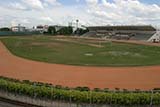
This was probably a nice facility when it was built but a few years ago (photo taken in 2005) the stadium looked as if it had been badly neglected for years and as a result it had started to crumble. Grey, run-down and depressing; it looked like a small piece of Eastern Europe during the Cold War era.
I saw a few runners using the track but not a lot else. The grassed football pitch had gone the same way as the stands. It was a real shame and quite saddening what had been allowed to happen.
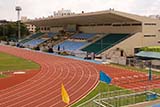
Wow! In October 2008 a sports festival involving all 14 southern Thai provinces was held at Jiranakorn stadium so I went along to take a look. I couldn't believe the difference in the stadium.
The stands, the running track, and the central playing area had all been fully refurbished. It looks great now. Safety-wise, there are still a few issues and I doubt that it would fully meet Western safety standards. The concrete stands are steep and completely open with no hand rails or crush barriers or anything to hold on to.
Despite that, it's a great improvement. I think it is Prai Pattano, the mayor, who is behind a lot of the improvements that are taking place in Hat Yai these days. He has a huge task on his hands but was given another term of office by the people of Hat Yai in 2008 and slowly things are getting better.
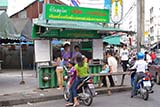
A little piece of Hat Yai street life, the juice bar on the corner of Suphasarnrangsan and Pracharak Roads (Map 2). It's a popular meeting place for youngsters in the evening. The fruit and herbal drinks on offer are cheap at 10 Baht and good for the body. Choose from roselle, guava, ginger or other more exotic beverages.
Latitude: N 07° 00' 31.1" (N 07° 00.518')
Longitude: E 100° 28' 23.0" (E 100° 28.383')
Google Maps: Street Map or Satellite View
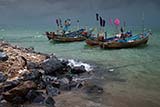
The pretty Muslim fishing village of Kao Seng in Songkhla with its handpainted boats all wearing brightly coloured sails is a photographers dream in the right light.
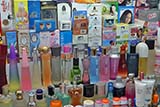
Hat Yai bills itself as a shopping paradise. My personal opinion is that there is very little worthwhile buying in the town but my tastes differ to most of the tourists I see wandering around. The green bottle labelled 'Baron' looks suspiciously like Faberge Brut, circa 1973. "Splash it all over."
These items were for sale in Gim Yong market so I would be a little suspicious as to the authenticity of some of the brand-name products. Along with the scents and colognes are a variety of bust-firming lotions and, of course, skin-whitening products (this is Thailand, after all).
I was confused by the 'Placenta AHA whitening' cream. Is this made from placentas or designed to whiten placentas? Is AHA an exclamation to signal recognition, or some magic ingredient?
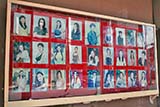
It is not difficult to work out one of the main attractions at many of Hat Yai's evening entertainment venues. Just in case there is any doubt, photographs of the delights within are prominently displayed outside on the street.
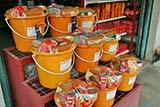
Making merit in this life in order to achieve a good rebirth in the next is an important part of Buddhism. A good way to do this is by buying one of these orange buckets full of food and toiletries to give to a monk.
Buddhists take refuge in the Triple Gem - the Buddha, Dharma and Sangha. Sangha is represented by the monks and nuns of the community who lead exemplary lives and are thus accorded great respect in Thailand and other Buddhist countries.
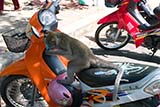
Monkeys riding motorbikes are a far more common sight in Hat Yai than you may think. They can often be seen wearing school uniforms. They love speed, they have no consideration for the safety of pedestrians or other road users, they like to ride along with their front wheels lifted off the ground, they don't like the idea of traffic laws, and their motorbikes have specially adapted exhausts to make lots of noise.
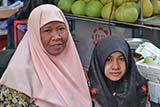
Thais are really funny about having their photo taken. At times I've been waved away or given quite severe looks for taking photos uninvited. At other times when I've been carrying a camera, they have insisted on having their photo taken.
This Muslim woman and her daughter own a fruit stall at Gim Yong market. I only wanted to photograph some of their fruit but they insisted I take their photo. I got the photo printed a couple of days later and gave it to them which was something they appreciated.
Hat Yai has a large Muslim population and they are generally nice people. People of different races and religions get along totally naturally in Thailand and, unlike some other countries, there is no need for the government to run campaigns to promote the idea of racial harmony. It just happens naturally.
This is what makes the problems in Thailand's deep south so difficult to understand. Any kind of confrontation or conflict is just so 'un-Thai'.

Most foreigners passing through Hat Yai spend a night in the crowded, frenetic downturn area and leave; vowing never to return and telling the world what a dump the town is.
The area of Hat Yai up near the hills could not be any different to the downtown area. Apart from an occasional motorbike, not a single vehicle van be heard; the only sounds come from the many colourful birds that can be seen swooping from tree to tree.
A particularly pleasant area is located just behind the rubber research centre on Karnchanawanit Road. There is a small lake, some old-fashioned houses and fields of rubber and other crops. It feels as if it is an extremely remote area of Thailand but all the shops and facilities of Hat Yai are just a few kilometres away.
Places of Natural Beauty around Hat Yai
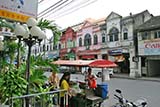
A few old buildings near the station are all that remain of Hat Yai's Sino-Portuguese architecture. The location is Niphat Uthit 1 Road opposite King's Hotel (Map 3).
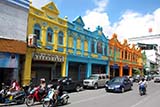
For a long time it troubled me that these wonderful old buildings had been neglected so badly. The southern Thai climate provides a tough environment for buildings. Sometimes it is intensely hot and at other times it is intensely wet.
I was therefore delighted in late 2011 to see that they have all been repainted. It is very positive that Hat Yai is trying to preserve and protect what little heritage it has left.
And besides, they now look great too!
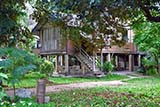
Behind Robinson department store near the train station is a small area with several old wooden houses on stilts designed in the classic Thai style. They are set amidst banana and coconut palms giving a totally different feel to the concrete and skyscrapers of central Hat Yai just a stone's throw away.
Presumably this is what all of Hat Yai looked like 20 or 30 years ago?
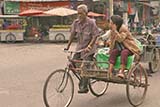
Bangkok is changing at a frightening pace but glimpses of an older way of life (operating at a much slower pace) are still evident in the rest of Thailand, including Hat Yai.
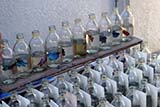
Fish for sale on Phetkasem Road to stock peoples' aquariums and fish tanks. The poor things are kept in small bottles with hardly enough room to move.